
Daikin Mini-Split Systems for Phoenix Properties
Daikin ductless applications relevant to Sapper Heating & Cooling, covering verified product families, inverter-driven operation, installation, and Phoenix heat considerations.
- 1. [Home](https://sapperhvac.com/)
- 2. [HVAC Resources](https://sapperhvac.com/hvac-resources/)
- 3. Daikin Mini Splits Phoenix
- Daikin Ductless Guide
- Veteran-Owned
- Arizona ROC #360142
Phoenix Metro
Why does Daikin have a strong position in inverter ductless?
Daikin is one of the original inverter-driven ductless manufacturers, with a long engineering history in variable-capacity compressor modulation. That inverter heritage is why Daikin holds a strong position in ductless HVAC: continuous modulation reduces short-cycling, holds steadier temperatures, and matches output to the load rather than running at full power every cycle. In Phoenix, where ductless systems often run for long hours in garages and supplemental zones, that inverter operation matters.
Which Daikin ductless families does Sapper install?
Sapper installs verified Daikin ductless equipment already represented in our lineup. We do not invent specifications or list model numbers we have not verified. Verified families include:
- ENTRAVerified Daikin ductless family represented by Sapper for wall-mounted applications.
- OTERRAVerified Daikin ductless family represented by Sapper for wall-mounted applications.
The correct product family depends on the application, capacity, and indoor-unit style required. Sapper confirms the right family for each installation rather than defaulting.
Where do Daikin mini splits fit in Phoenix homes?
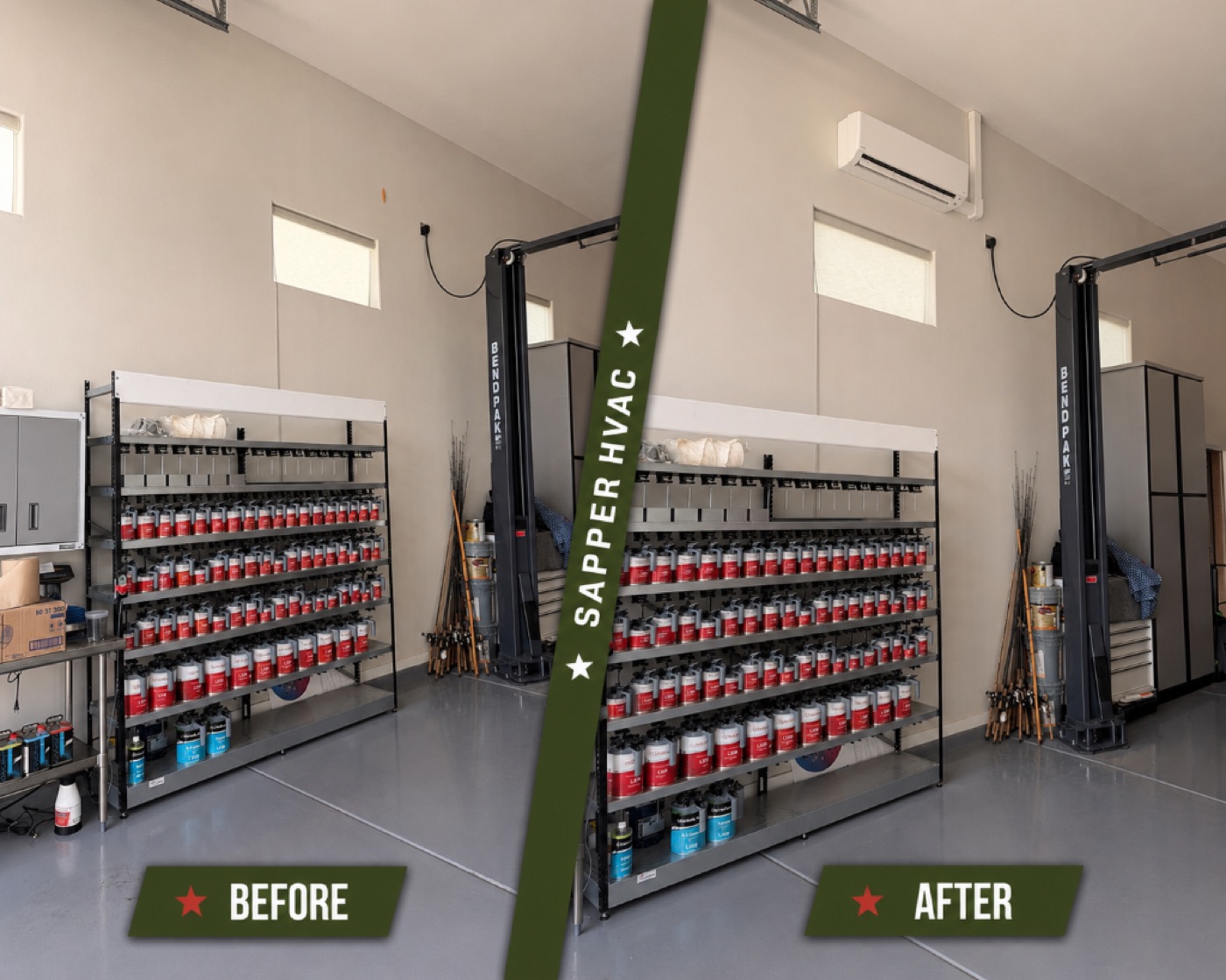
Daikin ductless systems fit spaces where running ductwork is impractical or where zoned comfort is the goal. Common applications Sapper installs across the Phoenix Metro include:
Garages
Bedrooms
Additions
Casitas
Workshops
Home offices
Arizona rooms
Supplemental zones
What are the strengths of Daikin mini splits?
- Long inverter engineering heritage in variable-capacity ductless.
- Continuous modulation that reduces short-cycling and holds steadier temperatures.
- Ductless design that fits garages, casitas, additions, and supplemental zones.
- Heat pump operation for both cooling and heating from one system.
- Verified product families Sapper represents, including ENTRA and OTERRA.
What should homeowners consider with Daikin mini splits?
- Premium inverter positioning means a higher investment than value-oriented ductless.
- Correct sizing is required; an oversized inverter still short-cycles.
- Ductless requires line-set routing and condensate planning per installation.
- Electrical capacity must match the equipment, including 115V versus 230V.
- Indoor-unit placement affects airflow distribution and comfort.
How should a Daikin mini split be sized?
We do not invent specifications, and we do not size by square footage alone. Daikin mini-split sizing considers insulation, exposure, ceiling height, windows, hot equipment or vehicles, desired temperature, and usage. For garages, the load is driven by door insulation, wall insulation, attic insulation, west-facing exposure, hot vehicles, and garage door usage. The correct capacity comes from those conditions, not a generic chart, and Sapper evaluates the actual load for every installation.
Why does installation quality matter?
Installation quality often matters more than the platform. A Daikin mini split that is oversized, undercharged, poorly wired, or connected to a bad condensate path will underperform regardless of its inverter heritage. Sapper treats sizing, airflow, electrical, line-set routing, and workmanship as the foundation, with the equipment built on top, so the inverter benefits actually reach the property.
What electrical does a Daikin mini split require?
A Daikin mini split requires a dedicated circuit sized to the equipment, the correct breaker, and code-compliant wiring. Smaller units may run on a 115V circuit, while larger systems require a dedicated 230V circuit. Sapper confirms electrical capacity and handles the electrical work as part of the installation, so the system is safe and code-compliant.
How is condensate handled?
Every mini split produces condensate when it cools, and that water has to drain somewhere. In a garage, bedroom, or casita, condensate drainage depends on where the indoor unit is mounted and whether a gravity drain or a pump is needed. Sapper plans the condensate path as part of the installation so water does not pool in or around the space.
How is line-set routing handled?
The line-set connects the indoor unit to the outdoor condenser, carrying refrigerant and condensate. Routing the line-set cleanly matters for appearance and for HOA compliance. Sapper plans line-set routing as part of the installation, including concealed options where the layout allows, so the line-set is protected and unobtrusive.
Where should a Daikin indoor unit be placed?
Indoor-unit placement affects how evenly the space cools. The unit should distribute air across the room or workspace without blowing directly onto a bed, workbench, or parked vehicle, and it should clear shelving and doors. Sapper chooses placement based on the actual layout, not a default wall, because airflow distribution is what makes a ductless system effective.
How do Daikin mini splits handle Phoenix heat?
Phoenix has a long, high-load cooling season, and ductless systems in garages, casitas, and Arizona rooms often run under sustained demand. Inverter modulation helps Daikin systems match that demand without constant full-power cycling. For Phoenix applications, the long run hours are the main reason inverter operation is worth considering in a ductless system, and the reason correct sizing matters more here than in a mild climate.
Frequently asked questions
Why is Daikin a strong inverter ductless brand?
Daikin is one of the original inverter-driven ductless manufacturers, with a long engineering history in variable-capacity modulation. That inverter heritage gives Daikin a strong position in ductless HVAC because continuous compressor modulation reduces short-cycling and holds steadier temperatures, which matters in Phoenix's long cooling season.
Which Daikin ductless product families does Sapper install?
Sapper installs verified Daikin ductless equipment already represented in our lineup, including the ENTRA and OTERRA families. We do not invent specifications or list model numbers we have not verified. The correct product family depends on the application, capacity, and indoor-unit style required.
Are Daikin mini splits good for Phoenix garages?
Yes. Daikin inverter ductless systems handle the sustained load of a Phoenix garage well, and the ductless design fits garages where running ductwork is impractical. Sizing depends on garage insulation, door type, exposure, hot vehicles, and usage, not square footage alone.
Do Daikin mini splits heat and cool?
Yes. Daikin ductless systems are heat pumps that provide both cooling and heating from one indoor unit and outdoor condenser. That makes them useful year-round in Phoenix, where cooling is the dominant load but mild winter heating is still needed.
Where should a Daikin indoor unit be placed?
The indoor unit should be placed to distribute air across the space without blowing directly on a bed, workbench, or parked vehicle, and it should clear shelving and doors. Sapper chooses placement based on the actual layout, not a default wall, because airflow distribution is what makes a ductless system effective.
How should a Daikin mini split be sized for Phoenix?
A Daikin mini split should be sized by evaluating the actual load, including insulation, exposure, ceiling height, windows, hot equipment or vehicles, and desired temperature. Square-footage sizing does not work for garages or supplemental zones, where the load is driven by different factors than living space.
What electrical does a Daikin mini split require?
A Daikin mini split requires a dedicated circuit sized to the equipment, the correct breaker, and code-compliant wiring. Smaller units may run on a 115V circuit, while larger systems require a dedicated 230V circuit. Sapper confirms electrical capacity and handles the electrical work as part of the installation.
How is condensate handled on a Daikin mini split?
Every mini split produces condensate when it cools, and that water has to drain somewhere. The condensate path depends on where the indoor unit is mounted and whether a gravity drain or a pump is needed. Sapper plans the condensate path as part of the installation so water does not pool in or around the space.
Get a Daikin Mini-Split Estimate
Sapper HVAC installs Daikin ductless systems throughout the Phoenix Metro. Veteran-owned, Arizona ROC #360142.
Veteran-owned · AZ ROC #360142
Repair, Replacement or New Installation?
Need a repair? Sapper HVAC services systems installed by any contractor with a $149 service call. Planning a replacement or new installation? Estimates are free.