
Best Mini-Split Brands for Phoenix Garages
A practical comparison of the mini-split brands Sapper HVAC installs in Phoenix garages, workshops, detached garages, and RV garages, with the Arizona garage sizing rules that decide which system actually cools your space.
- 1. [Home](https://sapperhvac.com/)
- 2. [HVAC Resources](https://sapperhvac.com/hvac-resources/)
- 3. Best Mini-Split Brands for Phoenix Garages
- Garage Mini-Split Guide
- Veteran-Owned
- Arizona ROC #360142
Phoenix Metro
What is the best mini split for a Phoenix garage?
There is no single best mini split for every Phoenix garage. The best choice depends on the garage size, insulation, door type, exposure, and budget. Sapper HVAC installs Mitsubishi Electric, Daikin, AC Pro J-Series, AURUS SKY, and Everwell mini splits across the Phoenix Metro, each fitting a different position from premium to budget-conscious.
The most important rule is sizing: do not size an Arizona garage using a generic bedroom BTU-per-square-foot calculation. Garage loads are driven by insulation, exposure, hot vehicles, and usage, so the brand comes after the load.
Why are Phoenix garages difficult to cool?
Phoenix garages are difficult to cool because they combine high exterior exposure, minimal insulation, large uninsulated doors, hot vehicles radiating heat, and often high ceilings. A garage attached to the home shares a wall with conditioned space but the garage itself is usually not insulated to the same standard, so it acts like an oven in summer. That combination makes a generic square-footage calculation unreliable.
Why do mini splits work well in garages?
Mini splits work well in garages because they do not require ductwork, they mount high on the wall out of the way of vehicles and tools, and their inverter compressors handle the sustained load of a hot Phoenix garage efficiently. A mini split can cool a garage to a setpoint without conditioning the whole house, which makes it the right tool for the space.
Is Mitsubishi a good mini split for Phoenix garages?
Yes.
Mitsubishi Electric is a premium ductless option. Sapper HVAC installs Mitsubishi mini splits in Phoenix garages where the homeowner prioritizes premium comfort, quiet operation, and long-term reliability. Mitsubishi is the premium end of the garage mini-split spectrum, and it pairs well with garages used as workshops or living-adjacent spaces.
Is Daikin a good mini split for Phoenix garages?
Yes.
Daikin is a strong premium to mid-premium ductless manufacturer depending on the series and application. Sapper HVAC installs Daikin mini splits in Phoenix garages where the homeowner wants a premium ductless brand at a position that can fit between Mitsubishi and the value tier. The right Daikin series depends on the garage and the budget.
Is the AC Pro J-Series a good mini split for Phoenix garages?
Yes.
The AC Pro J-Series is one of Sapper HVAC's frequently recommended value-to-performance garage mini-split options. It balances inverter operation and value, which is a useful combination for Phoenix garages where the load is high and the run hours are long. For many homeowners, the J-Series is the sweet spot between premium ductless and budget options.
Is AURUS SKY a good mini split for Phoenix garages?
Yes, for the right application.
AURUS SKY is a budget-conscious inverter mini-split option. Sapper HVAC installs AURUS SKY in Phoenix garages where the budget is the priority and the application is appropriate. It provides inverter operation at a budget-conscious position, which can be the right fit for a garage that does not need a premium platform.
Is Everwell a good mini split for Phoenix garages?
Yes, for the right application.
Everwell is a cost-conscious, straightforward option for appropriate applications. Sapper HVAC installs Everwell mini splits in Phoenix garages where the goal is straightforward cooling at a cost-conscious position. Like every brand here, Everwell performs best when sized and installed correctly for the actual garage load.
How do the garage mini-split brands compare?
This table is a qualitative comparison. Where a specification cannot be verified from existing data, it is omitted rather than guessed. Confirm exact specifications, warranty, and ratings for the specific equipment quoted for your garage.
| Consideration | Mitsubishi | Daikin | AC Pro J-Series | AURUS SKY | Everwell |
|---|---|---|---|---|---|
| Brand | Mitsubishi Electric | Daikin | AC Pro J-Series | AURUS SKY | Everwell |
| Positioning | Premium ductless | Premium / mid-premium ductless | Value-to-performance | Budget-conscious inverter | Cost-conscious straightforward |
| Compressor type | Inverter | Inverter | Inverter | Inverter | Straightforward cooling |
| Best garage fit | Premium comfort priority | Premium/mid-premium fit | Value performance garage | Budget inverter garage | Cost-conscious application |
| Modulation | Matches load | Matches load | Matches load | Matches load | Standard operation |
| Noise approach | Quiet ductless operation | Quiet ductless operation | Quiet inverter operation | Inverter quieting | Standard ductless |
| Warranty | Verify per model & registration | Verify per model & registration | Verify per model & registration | Verify per model & registration | Verify per model & registration |
What should I consider for a small garage?
A small one-car garage or workshop still has a high load in Phoenix because the exterior exposure ratio is high relative to the floor area. A smaller-capacity mini split may fit, but the insulation, door, and exposure still matter. Sapper sizes small garages by the actual conditions, not by assuming a small space needs the smallest unit.
What should I consider for a two-car garage?
A two-car garage is the most common Phoenix garage mini-split application. The load depends on door insulation, ceiling height, west-facing exposure, and whether the garage is attached or detached. A single indoor head often serves a two-car garage, but the capacity and placement depend on the conditions evaluated on site.
What should I consider for a large or tandem garage?
A large or tandem garage has more volume and often more exterior wall exposure than a standard two-car garage. That can push the load high enough that a single head struggles to distribute air across the whole space. In those cases, capacity and airflow distribution are the deciding factors, and sometimes a multi-zone approach fits better.
What should I consider for a three-car garage?
A three-car garage has significant volume and exterior exposure, and often a wide door or multiple doors. Air distribution becomes a real concern, and a single indoor head may not reach across the space. Sapper evaluates whether a single zone or a multi-zone setup fits the layout, based on the actual conditions rather than a square-footage rule.
What should I consider for an RV garage or workshop?
An RV garage or workshop is the most demanding Phoenix garage mini-split application. The ceiling height is high, the door is large, the volume is large, and there may be equipment or vehicles adding heat. These spaces require a real load evaluation, and sometimes a multi-zone or higher-capacity approach. A generic calculation will almost always miss these spaces.
Do I need 115V or 230V for a garage mini split?
Whether a garage mini split runs on 115V or 230V depends on the capacity. Smaller units may run on a 115V circuit, while larger systems require a dedicated 230V circuit. The correct voltage depends on the equipment selected and the garage's existing electrical capacity, so Sapper confirms electrical requirements as part of every installation rather than assuming.
How does insulation affect garage mini-split sizing?
Insulation is one of the biggest factors in a Phoenix garage load. Door insulation, wall insulation, attic or ceiling insulation, and whether adjoining space is conditioned all change the load dramatically. A well-insulated garage needs less capacity than an uninsulated one of the same size, which is exactly why square-footage sizing fails for garages.
Where should the indoor head go in a garage?
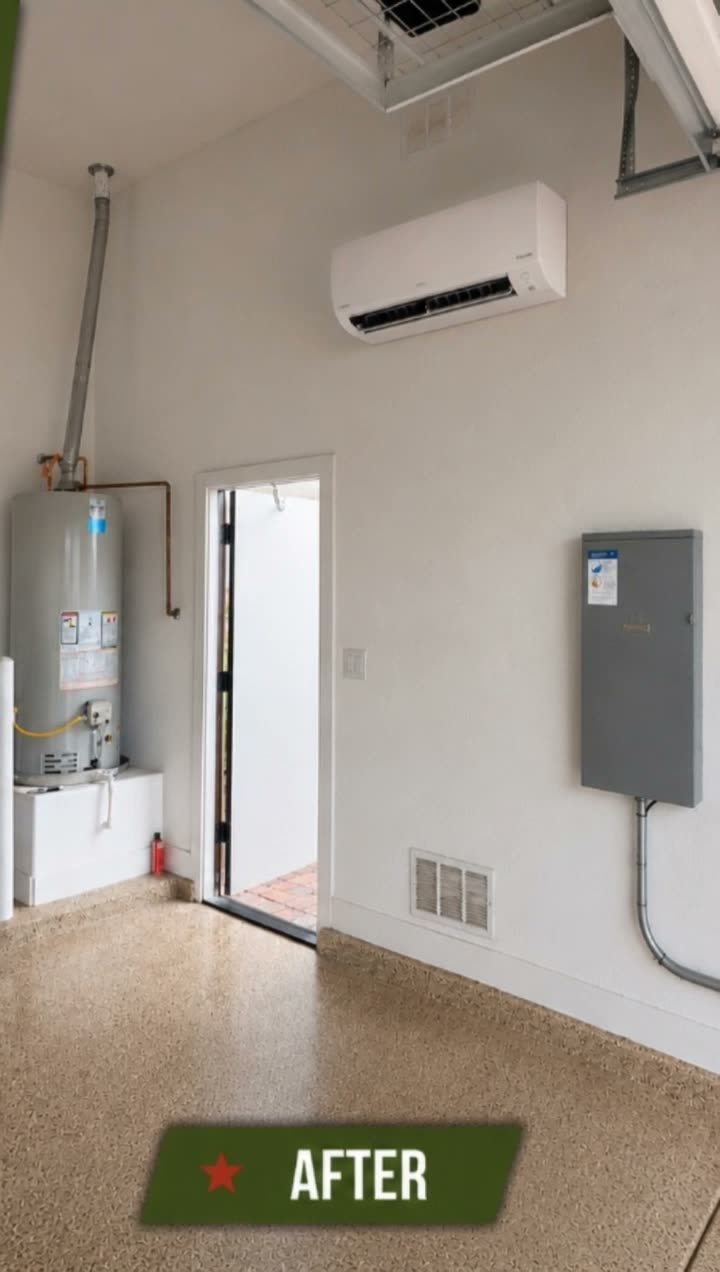
Indoor head placement affects how evenly the garage cools. The head should distribute air across the workspace without blowing directly onto a parked vehicle or work area, and it should clear shelving and overhead doors. Placement is chosen based on the actual layout, not a default wall, because airflow distribution is what makes a mini split effective in a garage.
Where should the garage mini split condenser go?
The condenser should be placed where it has airflow, is clear of debris, meets clearance requirements, and respects any HOA rules. For Phoenix garages, avoiding direct west-facing afternoon sun on the condenser is ideal when possible, though site constraints often decide the final location. Sapper accounts for clearance, airflow, and sun exposure when locating the condenser.
How is condensate managed in a garage mini split?
Every mini split produces condensate when it cools, and that water has to go somewhere. In a garage, condensate management depends on where the indoor head is mounted and whether a gravity drain or a pump is needed. Sapper plans the condensate path as part of the installation so water does not pool in or around the garage.
Does my HOA affect garage mini split installation?
Some HOAs restrict condenser placement, line-set visibility, or the exterior appearance of equipment. Sapper accounts for HOA considerations during planning, including concealed line-set options, so the installation meets both code and HOA requirements. If your HOA has rules, share them early so we can design around them.
Are concealed line-set options available?
The line-set connects the indoor head to the outdoor condenser, and in a garage it often has to cross a wall or ceiling. Concealed line-set options hide the refrigerant lines and condensate line inside a chase, wall, or trim, which matters for appearance and for HOA compliance. Sapper offers concealed line-set options where the layout allows.
What are the electrical requirements for a garage mini split?
A garage mini split requires a dedicated circuit sized to the equipment, the correct breaker, and code-compliant wiring. The electrical requirements vary by capacity and whether the unit is 115V or 230V. Sapper confirms electrical capacity and handles the electrical work as part of the installation, so the system is safe and code-compliant.
How do I properly select capacity for a garage mini split?
We do not blindly publish tonnage based on square footage. Arizona garage loads can be heavily affected by:
- door insulation
- wall insulation
- attic insulation
- ceiling height
- west-facing exposure
- exterior walls
- hot vehicles
- equipment
- desired temperature
- garage door usage
- windows
- adjoining conditioned space
The correct capacity comes from evaluating those conditions for your specific garage, not from a generic bedroom BTU-per-square-foot calculation. Sapper evaluates the garage and recommends capacity based on the actual load.
Frequently asked questions
What is the best mini split for a Phoenix garage?
There is no single best mini split for every Phoenix garage. The best choice depends on the garage size, insulation, door type, west-facing exposure, hot vehicles, equipment, and desired temperature. Sapper installs Mitsubishi, Daikin, AC Pro J-Series, AURUS SKY, and Everwell, and recommends the right fit after evaluating the actual garage load rather than square footage alone.
Why can't I size a garage mini split using a bedroom BTU-per-square-foot calculation?
Because Arizona garage loads are heavily affected by door insulation, wall insulation, attic insulation, ceiling height, west-facing exposure, exterior walls, hot vehicles, equipment, desired temperature, garage door usage, windows, and adjoining conditioned space. A bedroom calculation ignores those factors and routinely under-sizes or over-sizes a garage system, so we size garages based on the actual conditions.
Which mini split brands does Sapper install in Phoenix garages?
Sapper installs Mitsubishi Electric, Daikin, AC Pro J-Series, AURUS SKY, and Everwell mini splits throughout the Phoenix Metro. Each brand fits a different position, from premium (Mitsubishi) to budget-conscious (AURUS SKY and Everwell), so the choice depends on the garage and the budget.
Is the AC Pro J-Series a good mini split for a garage?
Yes. The AC Pro J-Series is one of Sapper's frequently recommended value-to-performance garage mini-split options. It balances inverter operation and value, which works well for Phoenix garages where the load is high and the run hours are long.
Do I need 115V or 230V for a garage mini split?
It depends on the capacity. Smaller mini splits may run on 115V, while larger systems require a dedicated 230V circuit. The correct voltage depends on the equipment selected and your garage's existing electrical capacity, so Sapper confirms electrical requirements as part of every installation.
Where should the indoor head go in a garage?
The indoor head should be placed to distribute air across the workspace without blowing directly onto a parked vehicle or work area, and clear of shelving or overhead doors. Placement affects how evenly the garage cools, so it is chosen based on the actual layout, not a default wall.
Where should the garage mini split condenser go?
The condenser should be placed where it has airflow, is clear of debris, meets clearance requirements, and respects any HOA rules. For Phoenix garages, avoiding west-facing afternoon sun exposure on the condenser is ideal when possible, though site constraints decide the final location.
Does my HOA affect garage mini split installation?
Yes. Some HOAs restrict condenser placement, line-set visibility, or the exterior appearance of equipment. Sapper accounts for HOA considerations during planning, including concealed line-set options, so the installation meets both code and HOA requirements.
How do I properly select capacity for a garage mini split?
We do not blindly publish tonnage based on square footage. Capacity is selected by evaluating door insulation, wall insulation, attic insulation, ceiling height, west-facing exposure, exterior walls, hot vehicles, equipment, desired temperature, garage door usage, windows, and adjoining conditioned space. The right capacity comes from those conditions, not a generic chart.
Get a Garage Mini-Split Estimate
Sapper HVAC installs garage mini splits throughout the Phoenix Metro. Veteran-owned, Arizona ROC #360142.
Veteran-owned · AZ ROC #360142
Repair, Replacement or New Installation?
Need a repair? Sapper HVAC services systems installed by any contractor with a $149 service call. Planning a replacement or new installation? Estimates are free.