

Quick Answer
Most Arizona garages need 30 to 45 BTU per square foot, above the 20 BTU per square foot used for living space. A two car garage lands around 18,000 to 24,000 BTU. A three car garage or insulated workshop needs 24,000 to 36,000 BTU. A load calculation on the actual space sets the final number.
Why do Arizona garages need more BTU per square foot than living space?
A garage is not conditioned space and was not built to hold temperature. The walls are uninsulated or carry thin insulation, and the attic above carries none. A large uninsulated metal or fiberglass door faces the sun for hours. The concrete slab absorbs heat all day and releases it at night. There is no return air path and no existing duct system. Vehicles park hot inside, and tools, freezers, and equipment add more heat load.
Systems here run against a summer design temperature near 108 degrees. A garage sized with a living space rule of thumb runs at full output all afternoon and does not catch up. The 20 BTU per square foot rule works for a bedroom with drywall and a vent above it. A garage has none of that. The real load lives in the door, the slab, and the walls, and a load calculation on the actual space is the only way to count it. For the install side, see our garage mini split installation in Phoenix guide. We cover what changes above 110 degrees in our guide to mini splits in 115 degree heat.
How many BTU do you need per square foot in an Arizona garage?
Plan on 30 to 45 BTU per square foot for an Arizona garage. The number moves with insulation, door type, orientation, and what happens inside the space.
Toward 30 BTU per square foot
- Insulated walls and ceiling
- Insulated garage door
- North or east facing
- Shaded by the house or mature trees
- Used for storage and light work
Toward 45 BTU per square foot
- Bare block or uninsulated frame walls
- Uninsulated metal door
- West or south facing with afternoon sun
- Full height or tall ceiling
- Gym equipment, welding, a second refrigerator, or a freezer running
Insulating the door and ceiling first lets you buy a smaller system and run lower bills for the life of it. That tradeoff pays back every summer. If you want to weigh the investment first, read our take on whether a garage mini split is worth it. For efficiency ratings, see is 18 SEER enough in Arizona.
What size mini split does each garage size need?
Match the system to the garage, not the other way around. These are starting ranges. A load calculation on the actual garage sets the final number.
| Garage | Typical size | Starting BTU range | Nominal tons |
|---|---|---|---|
| Single car | 200 to 300 sq ft | 9,000 to 12,000 BTU | 0.75 to 1 ton |
| Two car | 400 to 500 sq ft | 18,000 to 24,000 BTU | 1.5 to 2 ton |
| Three car | 600 to 800 sq ft | 24,000 to 36,000 BTU | 2 to 3 ton |
| Workshop or shop building | 800 to 1,200 sq ft | 36,000 to 48,000 BTU | 3 to 4 ton |
Most Phoenix two car garages land on a 24,000 BTU system once the door and ceiling load get counted. That is the common recommendation here for a standard attached garage with an uninsulated door. See a real Phoenix garage install for proof of how that number holds up on a 108 degree day. For the full method behind these ranges, read how to size a mini split in Arizona.
What happens if you undersize or oversize a garage mini split?
Undersizing and oversizing both cost you. One runs the system into the ground, the other short cycles it to death.
Undersized
The system runs at full output through the afternoon, does not reach setpoint, draws extra electricity compared to a right sized unit, and shortens compressor life. In a Phoenix July it can lose ground after two in the afternoon.
Oversized
The system brings the temperature down, shuts off, and short cycles. That leaves humidity in the space during monsoon season, stresses the compressor beyond steady operation, and carries a higher upfront cost for worse comfort.
A load calculation on the actual garage, accounting for door type, insulation, orientation, and ceiling height, replaces the guess. Read our Manual J load calculation guide for the method behind it.
What else does a garage mini split installation need?
A garage mini split needs more than the box on the wall. The install has to handle electrical, drainage, and placement details a bedroom install does not.
- A dedicated electrical circuit and disconnect at the outdoor unit
- Condensate drainage routed somewhere it will not pool on the slab
- Line set routing that keeps the run short and out of direct afternoon sun
- Mounting height that clears the garage door track and opener
- Wall or ceiling cassette placement that moves air across the whole bay
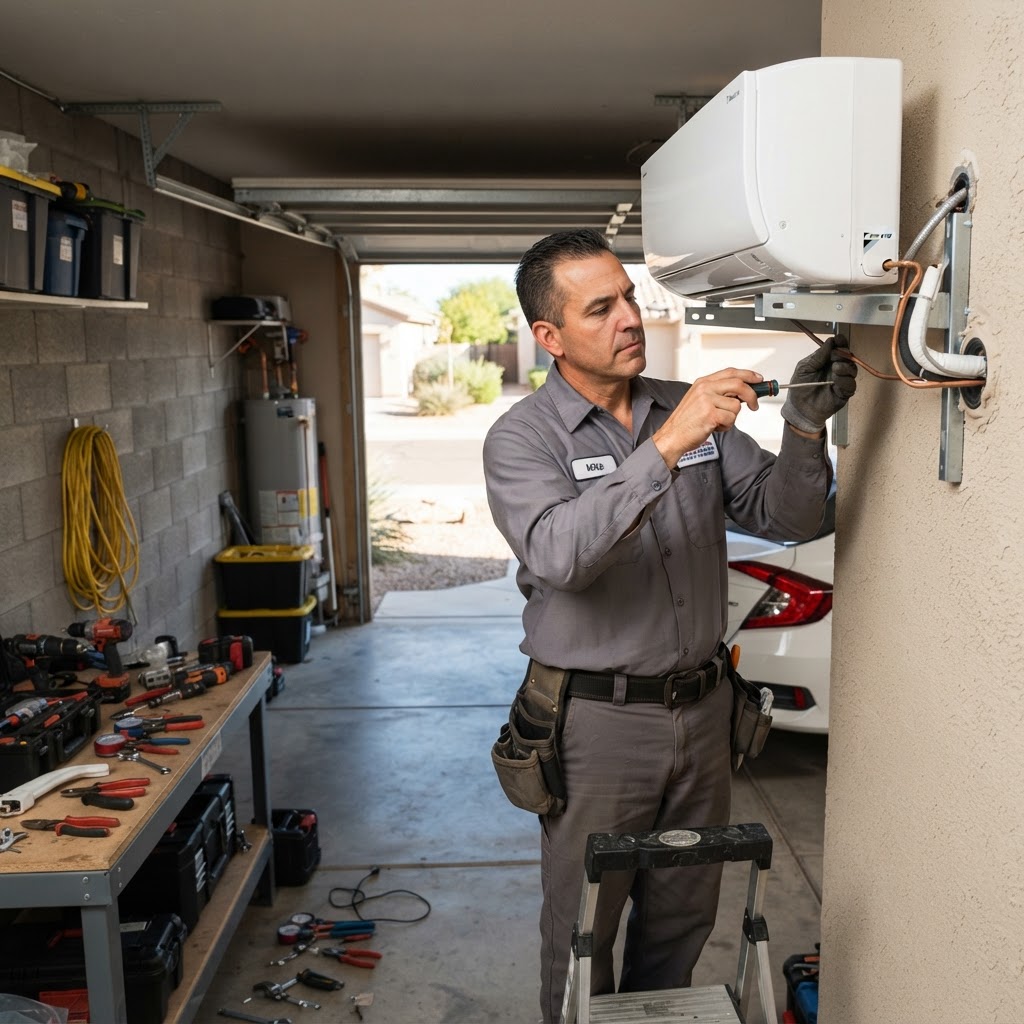
We install garage mini splits as an Daikin installer and handle the electrical, the drainage, and the placement on every job. See mini split installation cost in Phoenix for what drives the number. Check our service areas across the Phoenix metro to confirm we cover your city, including Gilbert, Mesa, and Goodyear. See $0 down financing options if you want to spread the cost.
Arizona Garage Mini Split Sizing Questions
What size mini split do I need for a two car garage in Arizona?
+
Most two car garages in Arizona run 400 to 500 square feet and need 18,000 to 24,000 BTU. Uninsulated doors, west facing walls, and tall ceilings push that toward 24,000 BTU. A load calculation on your actual garage sets the final number.
Is 24,000 BTU enough for a three car garage?
+
Sometimes. A well insulated three car garage on the smaller end can work at 24,000 BTU. A larger one with a bare uninsulated door and afternoon sun exposure usually needs 30,000 to 36,000 BTU to hold temperature through a Phoenix afternoon.
How many BTU per square foot does an Arizona garage need?
+
Plan on 30 to 45 BTU per square foot, compared to about 20 BTU per square foot for conditioned living space. Garages carry heat load from uninsulated doors, bare walls, a hot slab, and no return air path.
Should I insulate my garage before installing a mini split?
+
Insulating the door and ceiling first lets you install a smaller system and run lower electric bills for the life of it. If the budget covers only one, the garage door is the single largest heat source in most Arizona garages.
Garage Mini Split Promo
Cool Your Garage. Watch Football On Us.
Install a new qualifying Daikin mini split rated at 24,000 BTU or larger in your garage and Sapper HVAC includes a free season of Sunday football coverage with your installation. That covers most two car and three car garages in the Valley, which is the same size range this guide recommends.
- ✓ Qualifying Daikin systems rated 24,000 BTU or larger
- ✓ High efficiency heating and cooling
- ✓ Quiet operation
- ✓ Professional installation by a licensed crew
- ✓ Veteran owned and Arizona proud
- ✓ Straightforward recommendations and honest pricing
Sapper HVAC is not affiliated with, endorsed by, or sponsored by any professional sports league, team, or broadcaster.
Limited time promotional offer. Requires installation of a new qualifying Daikin mini split system rated at 24,000 BTU or larger in a garage application. Additional terms and restrictions apply. Contact Sapper HVAC for full details.
Not Sure What Size Your Garage Needs?
Sapper HVAC measures the space, counts the real heat load, and tells you the size that fits. Veteran owned, licensed in Arizona, ROC 360142.
Written by Kevin Harper, Owner
Veteran owned HVAC contractor serving Phoenix Metro. AZ ROC licensed #360142, EPA Section 608 compliant refrigerant handling. Sapper HVAC installs Daikin mini splits across the Valley.