

Quick Answer
The biggest movers on a Phoenix summer bill are a clean filter, the thermostat fan switched from ON to AUTO, and two feet of clear space around the outdoor unit. Shifting big loads out of your utility on peak window comes next. None of these require new equipment.
| What to do | Effort | Why it works |
|---|---|---|
| Change the filter on a calendar | Low | A clean filter improves airflow |
| Switch fan from ON to AUTO | Free | AUTO stops warm attic air mixing |
| Pick one temperature and hold it | Low | Constant setpoint changes waste run time |
| Pre cool before on peak hours | Low | Cool storage carries the expensive window |
| Clear two feet around the unit | Low | Open air lets the condenser reject heat |
| Rinse the condenser coil | Low | A clean coil drops heat without strain |
| Shade the unit without choking it | Medium | Shade helps if air moves through it |
| Close west and south blinds by noon | Low | Blocked sun stops heat at the glass |
| Leave every supply vent open | Free | Open vents keep static pressure normal |
| Find and seal duct leaks | Medium | Sealed ducts deliver cool air to rooms |
| Move big loads off peak | Low | Shifted loads avoid the demand hour |
| Get a tune up and check the split | Medium | A tuned system delivers cooling per watt |
Results vary with your home, equipment, usage, utility rate plan, and installation details. These are general tips, not guarantees.
1. Change the Filter on a Calendar, Not a Feeling
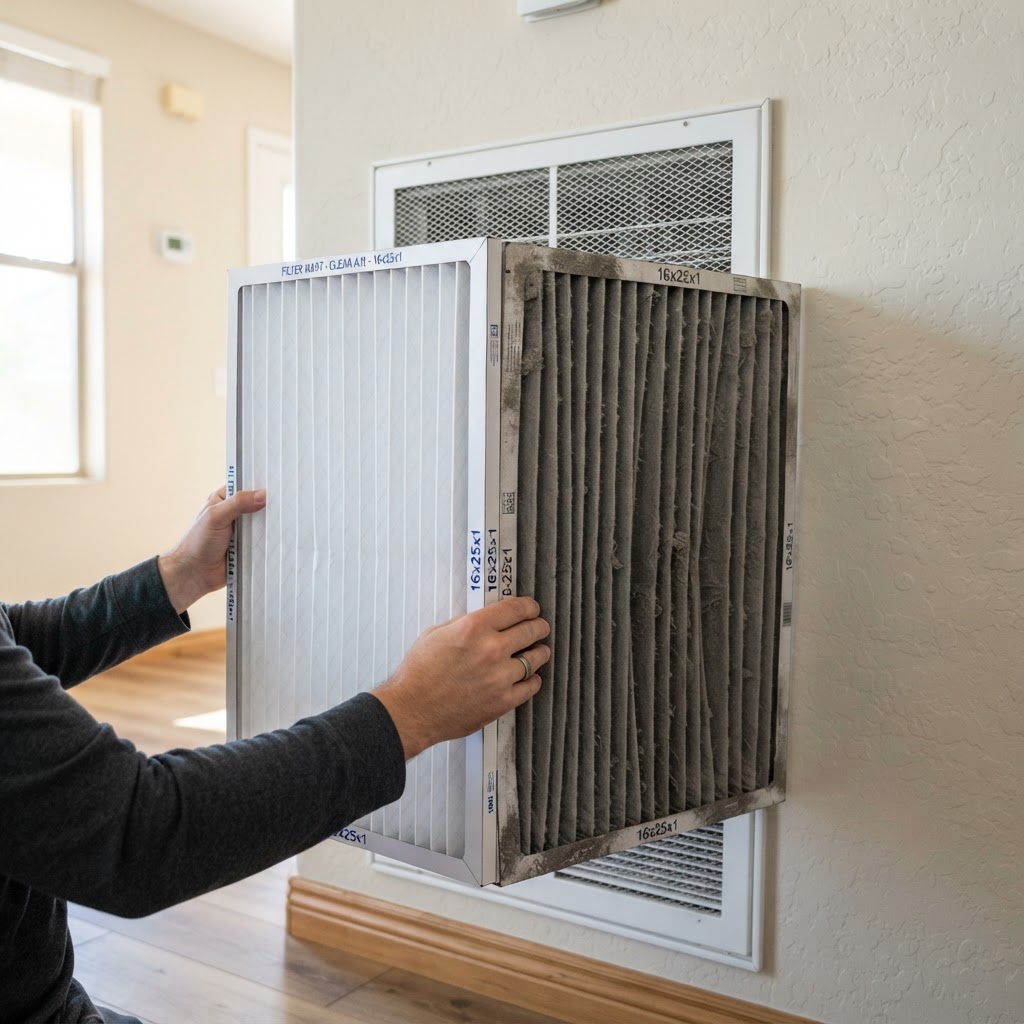
A loaded filter chokes airflow and starves the system of the air it needs to cool your home. Check the filter about every 30 days from May through October because Phoenix dust loads exceed most of the country, though your pets, home, and filter type change the interval. A one inch filter loads before a four or five inch media filter does. A higher MERV number catches more particles but restricts airflow in trade, so the right filter is a balance and not a race to the top rating. Read our guide on which MERV rating to buy before you grab the thickest filter on the shelf. A HVAC maintenance schedule keeps the dust in check.
2. Switch the Thermostat Fan From ON to AUTO
The fan setting labeled ON runs the blower around the clock, including hours when the system does not cool. That moves warm attic air through the ducts between cooling cycles and re-evaporates moisture off the coil. Set the fan to AUTO and leave it. The one exception is a short circulation schedule some smart thermostats run for even temperatures. This is the single fastest free change on the list. If you want a thermostat that handles this for you, smart thermostat installation in Phoenix makes the switch permanent.
3. Pick One Temperature and Stop Riding the Thermostat
Constant setpoint changes cost more than they save because the system spends its time recovering. Pick a comfortable number and hold it. Every degree higher on the setpoint cuts run time. Find the highest temperature that feels fine with a fan running, and hold that setting. A system in a 115 degree afternoon cannot drop the house 15 degrees in an hour no matter what the thermostat reads. Pick your number, set it, and stop chasing the dial.
4. Pre Cool Before Your Utility On Peak Window Starts
On APS residential time of use plans, on peak runs 4pm to 7pm on weekdays. On the SRP E 27 plan, summer on peak runs 2pm to 8pm on weekdays. Cool the house a few degrees below your normal setpoint before the window opens, and let the setpoint rise during it. The house holds the cool for part of the window and the compressor stays off during the expensive hours. Confirm your own window on your bill because plans differ. Check your APS time of use plan and SRP price plans for the exact terms.
5. Give the Outdoor Unit Two Feet of Clear Space
The condenser rejects heat into the air around it, and anything within two feet traps that heat and forces the unit to work against itself. Trim oleander, bougainvillea, and lantana. Pull weeds from the base. Move stored items off the pad. The specific Phoenix mistake is a decorative block screen built tight around the unit. Five feet of open space above the unit matters as much as the sides. Clear the pad and the system breathes.
6. Rinse the Condenser Coil
Dust, cottonwood fluff, and dryer lint pack into the outdoor coil fins and act like a blanket. Shut power off at the disconnect, and rinse the coil from the inside out with a garden hose on a gentle setting. Skip the pressure washer because it folds the fins flat and does permanent damage. Do this in spring and repeat in mid summer. A coil packed with grease or heavy buildup needs a chemical cleaning from a tech.
7. Shade the Unit Without Choking It
Shade over the condenser helps, but air must move through it. A tree or an awning placed above and to the side works. A cover, a tight enclosure, or a wall built close to the unit costs more than the shade returns. A west facing pad takes the worst afternoon load in the Valley. Air trapped around a hot condenser raises the head pressure and forces the compressor to draw more power. Do not cover the top of the unit at any point.
8. Close the Blinds on the West and South Sides by Noon
Direct sun through glass loads the house with heat the AC must remove. Close west and south facing blinds before the afternoon sun hits. Keep east windows covered in the morning. Solar screens and low emissivity film on the worst windows do the same job without daily effort. The glass that faces the afternoon sun dumps the most heat of the day into your living room. Block it before it enters and the AC runs for shorter stretches.
9. Stop Closing Vents in Empty Rooms
Closing supply vents does not save money on a standard duct system. It raises static pressure, pushes air through duct leaks, and can freeze the indoor coil. Leave every supply and return vent open and clear of furniture and rugs. The blower moves a fixed amount of air, and a closed vent sends that air to another room. A room you want to condition on its own calls for a mini split installation zone, not a closed vent.
10. Find the Duct Leaks in Your Attic
Duct leaks in a Phoenix attic dump cooled air into a space that runs above 140 degrees in July. Look for rooms that stay warm, weak airflow at a far register, and visible gaps or hanging insulation at duct connections. A tech seals joints with mastic, not cloth duct tape. This is a repair, not a replacement, and it costs less than people expect. The air you paid to cool belongs in your rooms, not above the ceiling.
11. Move the Big Loads Out of the Peak Window
Your AC is not the only thing running during the expensive hours. Set the pool pump timer to run outside the on peak window. Delay the dishwasher until after it closes. Do laundry in the morning or on weekends. Skip the oven on weekday afternoons. On a demand plan, running several large loads in the same hour sets a high demand number for the whole month. The peak windows come from item 4. Shift the big loads and the demand number drops.
12. Get a Tune Up and Verify the 20 Degree Split
A system low on refrigerant or running a weak capacitor burns power without delivering cooling, and no thermostat setting fixes that. A healthy system drops the air between the return and the supply register by about 20 degrees as a general rule, though the actual split varies with the system and conditions. Check it with a cheap thermometer. A split under 15 degrees points to a real problem worth a service call. Sapper HVAC is veteran owned, licensed under Arizona ROC 360142, and an authorized Daikin dealer. Book a free AC tune up and let a tech check the split for you. See the 20 degree rule for the full explanation.
What if Your Bill Still Will Not Come Down?
If the filter is clean, the coil is clear, the fan is on AUTO, and the bill climbs, the system itself is the problem. The three usual causes:
- A system undersized for the house from day one
- Equipment past 12 to 15 years old losing efficiency
- Refrigerant or electrical faults that need a tech
Get a diagnosis before you agree to a replacement quote. See AC repair cost in Phoenix and Arizona utility rebates for your next steps. If the diagnosis points to replacement, check AC replacement cost in Arizona and is 18 SEER enough in Arizona. Sapper HVAC offers HVAC service in Phoenix across service areas across the Valley including Chandler, Gilbert, and Mesa. Try the HVAC calculators and review financing options. See why your AC cannot get below 80 if the house stays warm.
Frequently Asked Questions
What temperature should I set my AC to in Phoenix during summer?
Set it to the highest temperature that still feels comfortable with a ceiling fan running, then leave it there. Every degree you raise the setpoint cuts run time. Constant adjustment costs more than it saves because the system spends its time recovering instead of holding.
Does turning the AC off while I am at work save money in Phoenix?
In extreme heat, a full shutoff often backfires. The house and everything in it soak up heat all day, and the system runs for hours to recover. A setback of a few degrees works better than switching the system off during a Phoenix summer afternoon.
Should the thermostat fan be on AUTO or ON?
Set it to AUTO. The ON setting runs the blower all day, pulls warm air through attic ducts between cooling cycles, and adds humidity back into the house. AUTO runs the blower only when the system cools.
Does closing vents in unused rooms lower my electric bill?
No. Closing supply vents raises static pressure in the duct system, forces more air out through duct leaks, and can freeze the indoor coil. Leave every vent open. A room that needs its own temperature calls for a mini split zone instead.
When are on peak hours for APS and SRP in the summer?
APS residential time of use plans run on peak from 4pm to 7pm on weekdays. The SRP E 27 plan runs summer on peak from 2pm to 8pm on weekdays. Plans differ, so confirm the window printed on your own bill before you build a schedule around it.
Free AC Tune Up Before the Next Bill Cycle
Sapper HVAC checks refrigerant charge, coil condition, airflow, and the temperature split across the Phoenix metro. Veteran owned, licensed under Arizona ROC 360142, and an authorized Daikin dealer.
602-206-7359Read our Google reviews