Quick Answer
On a 110 degree day, set the thermostat and leave it alone. Pre cool the house before noon. Clear the outdoor unit and change the filter. A healthy system holds about 20 degrees below outdoor air. It cannot hold 72 when it hits 115 outside, and chasing that setting freezes the coils.
What should you do the week before a heat wave?
Fix the small stuff while the system has slack, because a 110 degree day exposes every weakness at once. The work you do now buys you headroom on the day the thermostat never stops running.
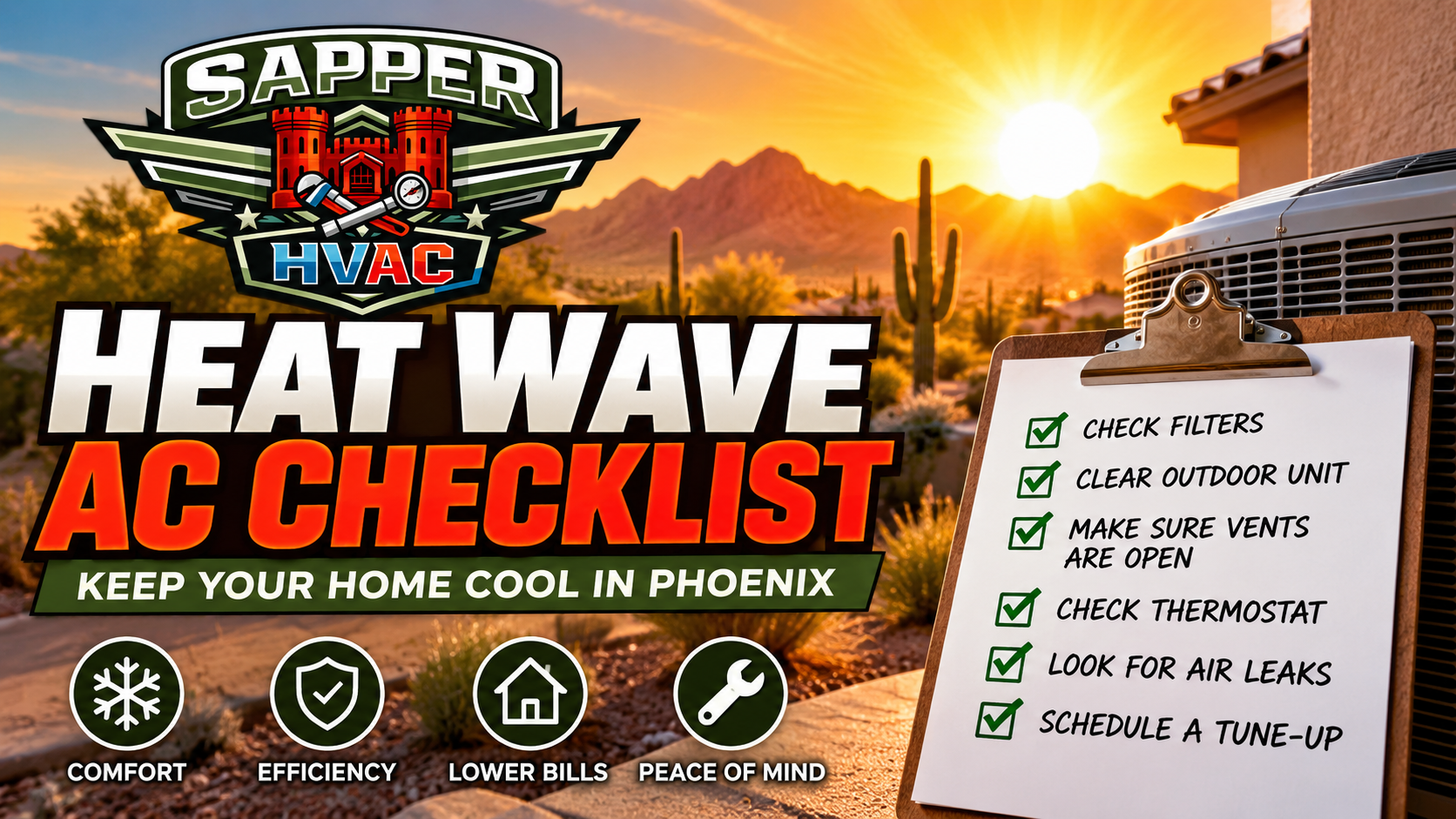
Run through this checklist before the forecast calls for 110:
- Change the filter. A loaded filter chokes airflow at the exact moment the system needs every bit of it. Read our guide to the right filter for a Phoenix home before you buy.
- Clear three feet around the outdoor unit. Pull weeds, move the trash cans, cut back the oleander.
- Rinse the condenser coil with a garden hose from the inside out with the power off at the disconnect.
- Check the supply registers. Open every one, including the rooms nobody uses.
- Walk the attic and look for a disconnected duct run or a crushed flex line.
- Book a tune up before June. The valley runs on a first come schedule in July. Schedule a free AC tune up while the calendar has room.
Six items, one afternoon, and your system walks into the heat wave with a full tank instead of running on empty.
What temperature should you set the thermostat during a heat wave?
Pick one setting and leave it there. Most valley homes hold at 78 to 80 during peak heat without the system running nonstop.
A central AC pulls the indoor temperature down about 20 degrees below what it faces outside. So 115 outside means low to mid 90s is the ceiling on raw capacity before insulation and shade do their part. Dropping the setting to 68 does not make the air colder. It makes the system run without a break, which raises the bill and risks a frozen coil. Read our guide on the 20 degree rule for the full breakdown.
The mistake people make is chasing 72 all afternoon. The system has one speed. It runs or it does not. A lower setting does not increase the output. It removes the rest the compressor gets, and that rest is what keeps the coil from freezing.
Then run the pre cool play. Set the house 2 to 3 degrees cooler than your hold setting from 6 a.m. to 11 a.m., then let it drift back up. The building mass carries the load through the worst hours. Concrete floors, interior walls, and furniture store cool air all morning and release it through the afternoon. That stored cool buys you two or three degrees of headroom when the sun peaks. The house starts the afternoon at 76, not 79, and the system spends the peak hours catching up, not falling behind.
What should you do during the 110 degree day?
Reduce the load on the system and stay out of its way. Every degree you keep out of the house is a degree the system does not have to remove.
| Time | What to do |
|---|---|
| 6 a.m. to 11 a.m. | Pre cool the house. Run laundry, dishwasher, and oven now if at all. |
| 11 a.m. to 4 p.m. | Close blinds on west and south windows. Skip the oven. Run ceiling fans in rooms you occupy. |
| 4 p.m. to 8 p.m. | Peak strain. Do not lower the thermostat. Keep interior doors open so return air has a path. |
| After 8 p.m. | Check that the house recovers. A system that never catches up after sundown needs a service call. |
A few things help more than people expect. Set ceiling fans to counterclockwise so they push air down on the people below. Close the garage door on the sunny side. Leave interior doors open so the return can breathe. Fans cool people, not rooms, so turn them off in empty rooms.
If a back bedroom falls behind while the rest holds, ductwork may be the reason one room falls behind. A room that never catches up on a 110 degree day has a delivery problem, not a thermostat problem.
What should you never do during a heat wave?
Some habits hurt more than they help. Cut these from your routine before the next heat wave.
- Do not drop the thermostat to 65 to force it to catch up. The system has one speed and that setting strips the off cycle and leaves the rest.
- Do not close vents in unused rooms. Closed vents raise duct pressure and starve the blower.
- Do not cover the outdoor unit for shade in a way that blocks airflow. The unit needs open air on all sides and above.
- Do not switch the fan from AUTO to ON during high humidity days in monsoon. It puts moisture back into the air.
- Do not keep resetting the breaker on a unit that keeps tripping. A repeat trip means a component failed. Call for compressor repair. Do not push the button a third time.
- Do not ignore ice on the refrigerant line. Shut the system off and let it thaw before you call. If the outdoor fan stopped, call for fan motor repair before the heat cooks the compressor.
Each of these feels like a fix. None of them are. A 110 degree day punishes guesswork, and the repair bill for a frozen coil or a burned compressor runs higher than the patience it takes to leave the thermostat alone.
Why does the AC freeze up when it gets hottest outside?
A frozen coil comes from restricted airflow, not from cold weather. The ice forms because the coil starves for warm air, and it happens on the hottest days because the system runs the longest.
Here is the chain. A dirty filter, a closed register, or a dirty evaporator coil blocks the warm air that keeps the coil above freezing. The coil temperature drops below 32 degrees, and condensation turns to ice. Once ice forms it blocks more airflow, so the problem feeds itself. The ice grows, the airflow shrinks, and the coil gets colder.
Run the response in order. Switch the system to OFF and the fan to ON. Let it thaw for two to four hours. Replace the filter, then restart. If it freezes again, the system has a refrigerant or airflow fault that needs a tech.
Do not chip the ice off the coil. The coil is copper and aluminum, and a scraper puts a hole in it. A pierced coil turns a thaw into a full system replacement. For more on what a frozen coil means, read our guide on when your AC cannot get below 80 degrees.
How do you protect the compressor in extreme heat?
The compressor fails from heat, restriction, and short cycling. You control two of those three, and the one you cannot control is the outdoor temperature.
- Keep the condenser coil clean so it can reject heat into 115 degree air.
- Give the unit three feet of clearance on all sides and open space above.
- Avoid the rapid on and off pattern that comes from chasing thermostat settings.
- Watch the outdoor fan. A fan that stops spinning cooks the compressor in minutes.
- On an older unit, ask your tech about a hard start kit and a surge protector. Both give the compressor an easier start and protect it from the voltage spikes that hit the whole grid on a 110 degree day.
A compressor is the most expensive component in the system. On a unit past 12 years the repair often approaches the cost of a replacement. If you face that decision, consider AC replacement and new system installation from an authorized Daikin installer. If the budget is the holdup, ask about $0 down financing. For context on efficiency, read our guide, is 18 SEER enough in Arizona, before you pick a system. You can read about compressor repair if the unit has service life left.
The compressor has no moving part you can service from the outside. What you can do is keep the coil clean, keep the fan running, and keep the thermostat steady. Those three habits add years to the most expensive part of the system.
When should you call for service instead of waiting it out?
Call when the system stops making progress, not when it runs hard. A system that runs all day on a 110 degree day is doing its job. A system that loses ground is not. The difference matters because the fix for a hard working system is patience, and the fix for a failing system is a phone call.
Call now if you see any of these:
- The house gains temperature through the afternoon and never recovers after sunset
- The gap between outdoor air and indoor air stays under 15 degrees
- The breaker trips more than once
- Ice forms on the line set or the indoor coil
- Water pools near the indoor unit or the drain pan overflows
- The outdoor fan sits still while the unit hums
- You smell a burning or electrical odor
Every HVAC shop in the valley runs a backlog on a 110 degree day. Call in the morning and describe the symptom with detail. A tech who hears "ice on the copper line" comes prepared. A tech who hears "it stopped" walks in without a starting point. Sapper HVAC serves the service areas across the Phoenix metro, including Chandler, Gilbert, and Mesa. Call 602-206-7359 and tell the dispatcher what you see.
A clear symptom gets a faster response. "The house was 79 at noon and hit 84 by 5 p.m. and never came back down" tells a tech more than "the AC is broken."
How do you stay safe if the AC fails?
Move to the coolest room, close the doors, and drink water. Get somewhere cooled if the indoor temperature keeps climbing past what you can stand. A failing AC in July is a safety issue, not a comfort issue. Do not wait for the house to hit 90 before you act.
Maricopa County runs a network of cooling centers through the summer, and the 211 Arizona line lists locations near you. Both resources stay open through the hottest months. Call 911 for signs of heat illness. Check on older neighbors, kids, and pets. A phone call takes less time than a hospital visit.
What should you check after the heat wave breaks?
The days after a heat wave are the best time to find what almost failed. The system showed you its weak spots. Write them down.
- Pull and inspect the filter. A filter that loaded in two weeks points to a duct or return problem.
- Check the condensate drain line for backup and clear the trap.
- Look for water stains on the ceiling under the air handler.
- Listen for new noise at startup and shutdown.
- Note which rooms fell behind and write them down while it is fresh. The details fade a week later, and a tech needs them to diagnose the problem.
- Book the service or duct evaluation now, while the schedule has room.
A system that barely survived July will not survive next July without attention. September is when a contractor can get to you. October works too. November turns into a rush. Book a free AC tune up or a duct evaluation before the next heat wave hits. If a back bedroom fell behind, read our guide on how ductwork may be the reason one room falls behind.
The cheapest repair is the one you make before the part fails. A heat wave tells you what to fix. Listen to it.
Frequently Asked Questions
What temperature should I set my AC when it is 110 outside?+
Set it between 78 and 80 and leave it there. A central AC holds about 20 degrees below the outdoor temperature, so a lower setting does not produce colder air. It removes the system's off cycle, raises the bill, and raises the odds of a frozen coil.
Why is my AC running nonstop but the house is not cooling?+
On a 110 degree day, continuous running is normal. The problem shows up when the house gains temperature through the afternoon and never recovers after sunset. That points to a capacity, airflow, or duct issue. Check the filter, confirm every register is open, then call for a diagnosis.
Should I turn my AC off during the day to save it?+
No. Shutting the system off lets the house and everything in it soak up heat, and the system runs longer to recover than it would have to maintain. Set one temperature and hold it. Pre cool in the morning when the outdoor air is cooler and the unit works less for the same result.
Why did my AC freeze up in the middle of summer?+
A frozen coil comes from restricted airflow or low refrigerant, not from cold weather. A loaded filter, closed registers, or a dirty coil starves the evaporator of warm air and the coil drops below freezing. Turn the system to OFF, set the fan to ON, let it thaw, and replace the filter before restarting.
How do I protect my AC compressor in extreme heat?+
Keep the condenser coil clean, give the outdoor unit three feet of clearance on all sides, and avoid changing the thermostat setting through the day. Confirm the outdoor fan spins whenever the unit runs. On an older system, ask your technician about a hard start kit and a surge protector.
Heat Wave Preparation
Do Not Wait for the Next 110 Degree Day
Sapper HVAC checks airflow, refrigerant charge, electrical, and duct condition before the heat hits. Veteran owned, licensed, and an authorized Daikin dealer serving the Phoenix metro. Book the free tune up while the schedule is open.