
Quick Answer
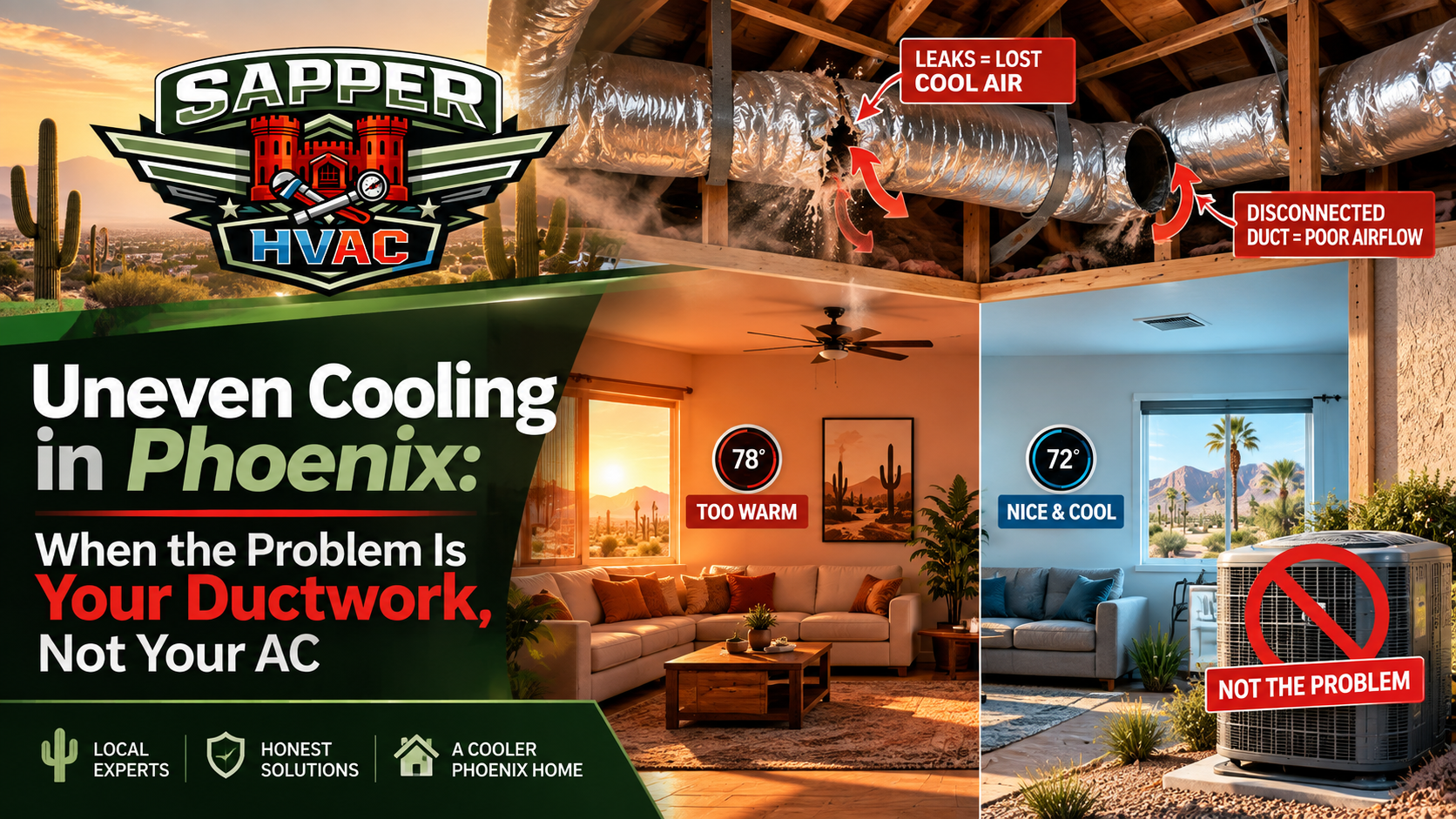
Uneven cooling points to the ducts more often than the AC. In Phoenix homes the ducts run through an attic that hits 150 degrees in July. Leaks, crushed flex runs, and undersized return air drain capacity before the air reaches the far rooms. A duct inspection finds the cause faster than a new system.
Why does one room stay hot when the AC runs all day?
The equipment makes cold air. The duct system delivers it. When one room falls behind while the thermostat reads fine, the delivery side broke, not the machine.
Most valley homes route supply ducts through a vented attic, and that attic runs 140 to 160 degrees on a July afternoon. Air that leaves the air handler at 55 degrees can arrive at the far bedroom 10 to 15 degrees warmer after a long attic run. The room at the end of the longest run loses first.
The farther the air travels, the more heat it picks up from the attic. A short, direct run to a bedroom near the air handler stays cold. A long run that crosses the full attic to a west facing room arrives warm. The AC did not fail. The duct turned a cold delivery into a warm one.
How do you tell if the ductwork is the problem and not the AC?
Check the pattern. A duct problem hits one or two rooms. An equipment problem hits the whole house at once. The table below splits the two.
| Points to the ducts | Points to the equipment |
|---|---|
| One or two rooms stay hot while the rest feel fine | Every room in the house falls behind at the same time |
| Weak airflow at one register, strong airflow at another | Weak airflow at every register |
| The problem started after a remodel, a re roof, or attic work | The problem started after a storm or a power event |
| Air at the register feels cold but the room never catches up | Air at the register feels warm at every vent |
| Dust builds at one or two supply vents | Ice forms on the refrigerant line at the outdoor unit |
Run the hand test. Hold your hand at each supply register with the system running and compare. Then close a door on a hot room, run the system, and see if the room gets worse. Rooms that get worse behind a closed door have a return air problem.
If your whole house falls behind instead of one room, read our guide on AC that cannot get below 80 degrees before you look at the duct side.
What do duct leaks cost you in a Phoenix attic?
A leaking duct dumps paid for cold air into the attic, and it pulls 150 degree attic air back into the return side. You pay to cool the attic while the living room falls behind.
Federal energy guidance puts typical duct losses in a range near 20 to 30 percent of the conditioned air moving through a system. That number comes from the Department of Energy and ENERGY STAR duct sealing guidance.
Make it local. A 4 ton system leaking a quarter of its output performs like a 3 ton system on the hottest day of the year. That is the day the homeowner notices. The system runs longer, the bill climbs, and the far room never catches up.
- The plenum connection at the air handler, where the main trunk meets the unit
- Boots where flex meets the ceiling register, a common spot for gaps
- Torn inner liner on aging flex duct, which opens over years of attic heat
- Disconnected runs knocked loose by attic traffic or storage work
- Old mastic that dried and cracked, leaving a gap at a joint that once sealed
Is your return air undersized?
Return air is the part most homes get wrong, and it causes more comfort complaints than any single supply problem. The system has to pull back everything it pushes out. When it cannot, supply airflow drops and the room stalls.
Many valley homes carry one central return for the whole house. Bedrooms with a closed door have no path for the air to get back. Pressure builds in the room, supply airflow drops at the register, and the room runs warm even though the AC works fine.
The fixes include a jumper duct, a transfer grille, a door undercut, or a dedicated return in the problem room. Each one gives the air a path back to the air handler.
A tech measures static pressure across the air handler and compares it to the equipment rating. High static is the number that proves a restriction exists. The same Manual J load calculation that covers equipment sizing also covers duct design, so the numbers tie together.
What else restricts airflow before it reaches the room?
Leaks are one half of the problem. Restriction is the other half. A duct can seal tight and still deliver weak airflow if something chokes the run.
- Flex duct crushed under stored boxes or stepped on during attic work
- Long flex runs left with slack and sag, which act like a series of speed bumps
- Sharp turns and pinched elbows at the takeoff
- Undersized trunk line left over from an addition that added square footage without adding duct
- A closed or rusted damper someone set years ago and forgot
- A filter rated too restrictive for the blower
On the filter point, read our guide to the right MERV rating for a Phoenix home before you upgrade. A filter that catches more dust can also choke a blower that was not sized for it.
Can sealing and balancing fix it, or do you need duct replacement?
Most homes fix uneven cooling with sealing, added return, and balancing. Replacement makes sense when the duct system fails on design, not on condition.
| Fix | When it makes sense | What it involves |
|---|---|---|
| Seal and repair | Leaks at boots and plenums, a few disconnected runs, duct in good condition | Mastic and mesh at connections, reconnecting runs, replacing torn sections |
| Add return and balance | One or two rooms lag, closed doors make it worse, static pressure runs high | Jumper ducts or transfer grilles, damper adjustment, airflow readings at each register |
| Replace the duct system | Original duct past its service life, undersized trunk, crushed liner throughout, duct added onto over multiple remodels | New trunk and runs sized from a load calculation, sealed and insulated to current code |
Sealing and balancing lands far below the cost of a system replacement. Full duct replacement runs as a project priced by the size of the home and the attic access. Get the scope in writing either way.
For an addition or a converted room where adding duct costs more than a ductless head, consider a ductless mini split for the room that never catches up. A single zone unit skips the attic run and delivers cold air direct to the problem space. See our guide on how to size a mini split in Arizona before you pick a BTU rating.
Do bad ducts affect the air you breathe?
Yes. A leaking return pulls attic air into the house, and attic air carries insulation fibers, dust, rodent waste, and whatever blew through the roof vents.
A leak on the return side sucks. A leak on the supply side blows. The return side leak is the one that changes the air in your house, because it pulls outside air in rather than pushing conditioned air out.
The signs you already see: dust that returns a day after cleaning, a filter that loads faster than it should, and allergy symptoms that spike indoors. The health claims here stay general. Duct sealing cuts what circulates, but no contractor should claim the work treats a medical condition.
Where does attic insulation fit in?
Insulation and ductwork solve the same problem from two sides, and fixing one without checking the other leaves money on the table. Sealed ducts in a 155 degree attic still fight the heat load pressing down through a thin ceiling.
Adding insulation drops the attic temperature the ducts sit in, which means less heat gain on every run. Sapper installs attic insulation, so one crew can look at the whole picture on one visit instead of sending you to a second contractor.
Check the ducts first. A disconnected run beats any insulation upgrade for immediate effect. Fix the delivery, then improve the envelope.
What should a duct diagnosis include?
A real duct evaluation gives you numbers, not guesses. Hold any contractor to this checklist:
- Airflow measured at every supply register, not guessed by hand
- Static pressure read across the air handler and compared to the equipment rating
- Return air sizing checked against the system tonnage
- Visual attic inspection of every accessible run, boot, and plenum
- Temperature split measured at the equipment and at the far register
- A written scope that separates sealing, balancing, and replacement into priced line items
A contractor who quotes a new system before measuring airflow skipped the diagnosis. Sapper HVAC is a veteran owned Phoenix contractor that runs the numbers before it quotes equipment. The team works across service areas across the Phoenix metro, including Chandler, Gilbert, and Mesa.
When you need central heating and air installation, look for an authorized Daikin installer who measures first. If the budget is the holdup, ask about $0 down financing before you decide. And if your system runs all day and never satisfies the thermostat, check the 20 degree rule to see if the equipment is doing its job or the ducts are stealing the output.
Frequently Asked Questions
Why is one room hotter than the rest of my house in Phoenix?+
One hot room points to the duct serving that room. The run may leak into the attic, sag, sit crushed, or end too far from the air handler to deliver cold air. A closed damper or a missing return path causes the same result. Have the airflow measured at that register before you consider new equipment.
How do I know if my ducts are leaking?+
Watch for weak airflow at one register while others feel strong, dust building at supply vents, a filter that loads fast, and rooms that never catch up on hot afternoons. A technician confirms leaks with a static pressure reading and an attic inspection of the plenum, the boots, and every accessible run.
Does duct sealing fix uneven cooling?+
Duct sealing fixes uneven cooling when leaks cause it. Sealing does nothing for a room that lacks a return path or sits at the end of an undersized trunk line. A full evaluation measures airflow and static pressure first, then matches the fix to the cause.
Should I replace my ductwork or my AC first?+
Check the ducts first. A new system pushed through a leaking, undersized duct system delivers the same uneven results as the old one. If the duct system needs replacement, doing it during an equipment change costs less than doing it as a separate project later.
Do bad ducts make indoor air worse?+
Yes. Leaks on the return side pull attic air into the house, and that air carries dust, insulation fibers, and debris. Sealing the return side and matching the filter to the system cuts what circulates through your home.
Duct Diagnosis
Find Out What Your Ducts Are Costing You
Sapper HVAC measures airflow, static pressure, and return sizing before we quote a thing. Veteran owned, licensed, and an authorized Daikin dealer serving the Phoenix metro. Book a free AC tune up and we will check the duct side while we are there.