
Written by: Sunny Bert
Lead HVAC Technician | 30 Years Experience
EPA 608 Certified (Type I & II) | AZ ROC License #360142 | Former Owner, Pueblo Mechanical
Direct Answer
In Sapper HVAC's Phoenix Metro service area, central AC replacement commonly runs about $5,500–$12,000+ installed depending on system type, tonnage, efficiency, ductwork, electrical requirements, equipment location, and access. Standard split-system replacements often fall around $6,000–$9,500. Package, rooftop, high-efficiency, variable-capacity, ductwork-heavy, or electrical-intensive projects can cost more.
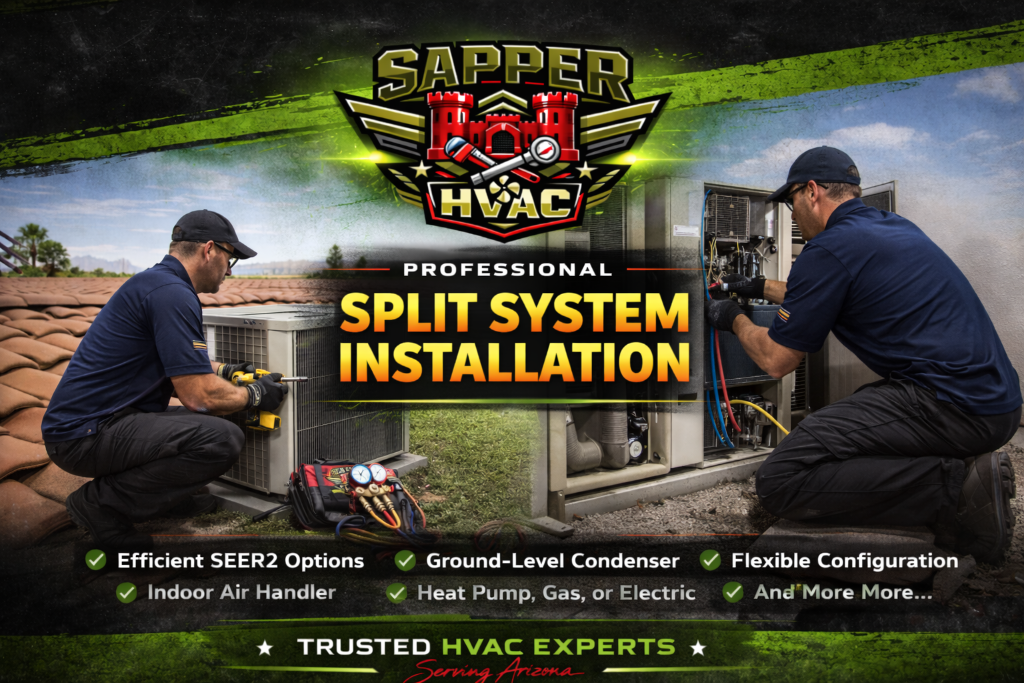
Split system installation in Chandler, AZ — Sapper HVAC
Average Cost to Replace an AC Unit in Arizona
For homeowners asking how much AC replacement costs in Arizona, a practical Phoenix Metro planning range for many central-system replacements is about $5,500–$12,000+ installed. Standard split-system replacements often fall around $6,000–$9,500. Your actual quote changes with system type, tonnage, efficiency, ductwork, electrical work, equipment location, access, and other installation requirements.
2026 Arizona AC Replacement Cost by System Type
| System Type | Home Size | Typical Installed Cost |
|---|---|---|
| Split System (Standard Efficiency) | 1,000–1,500 sq ft | $5,500–$7,500 |
| Split System (Standard Efficiency) | 1,500–2,500 sq ft | $6,000–$9,500 |
| Split System (Standard Efficiency) | 2,500–4,000 sq ft | $8,000–$12,000+ |
| Split System (High Efficiency / Variable Capacity) | Any size | Typically above standard-efficiency pricing |
| Package Unit (Gas or Electric) | 1,000–2,000 sq ft | $5,500–$10,000 |
| Package Unit (Heat Pump) | 1,000–2,000 sq ft | $6,000–$13,000+ |
| Mini Split — Single Zone | One room/garage | $2,500–$5,500+ |
| Mini Split — Multi-Zone (2–4 zones) | Multiple spaces | $5,000–$12,000+ |
| Heat Pump System | 1,500–2,500 sq ft | $6,500–$14,000+ |
Planning ranges for the Phoenix Metro, updated October 2026. Final price depends on the selected equipment and complete installation scope. Ductwork, electrical, crane/access, permits, and other project requirements can change the total.
What Drives AC Replacement Cost in Arizona?
Arizona replacement pricing varies because the equipment and installation scope vary from home to home. The largest drivers are system type, required capacity, efficiency, equipment location, ductwork, electrical requirements, controls, permits, and access.
System Capacity and Home Load
Required capacity affects both equipment selection and price. The correct size depends on more than square footage, so Sapper HVAC reviews insulation, windows, orientation, ceiling height, ductwork, and other load factors before recommending tonnage.
Longer Cooling Seasons Mean Faster Wear
Arizona's AC season runs from March through October. That is 7 to 8 months of meaningful runtime per year, compared to 3 to 4 months in most of the country. Systems here accumulate wear faster, which is why Arizona contractors hold installation standards to a higher level. A system installed with improper refrigerant charge or incorrect airflow will fail faster in Arizona's heat than it would anywhere else.
Quality Installation Is Non-Negotiable Here
In a mild climate, a borderline installation might run for years before its flaws show up. In Arizona's summer heat, shortcuts reveal themselves within the first few seasons. This is why the cheapest quote is rarely the right choice in the Phoenix Metro.
Do not assume the new system should automatically match the old system's tonnage. Home changes, ductwork, insulation, windows, equipment design, and the original sizing can all affect the right replacement. Ask how the contractor determined the recommended capacity.
AC Replacement Cost by Tonnage
Tonnage is the single biggest driver of equipment cost. Here is what Arizona homeowners typically pay by system size in 2026.
Cost by Tonnage (Split System, Standard Efficiency)
| System Size | Typical Home Size (AZ) | Equipment Cost | Installed Cost |
|---|---|---|---|
| 2.0 ton | Under 1,200 sq ft | $1,800–$2,800 | $4,000–$5,500 |
| 2.5 ton | 1,200–1,800 sq ft | $2,200–$3,200 | $4,500–$6,500 |
| 3.0 ton | 1,800–2,400 sq ft | $2,600–$3,800 | $5,500–$7,500 |
| 3.5 ton | 2,400–3,000 sq ft | $3,000–$4,500 | $6,500–$9,000 |
| 4.0 ton | 3,000–3,800 sq ft | $3,500–$5,200 | $7,500–$10,500 |
| 5.0 ton | 3,800–5,000 sq ft | $4,200–$6,500 | $9,000–$13,000 |
These are guidelines. Actual required tonnage is determined by a Manual J load calculation — not square footage alone.
What Affects the Final Price of Your AC Replacement
Beyond tonnage and system type, several factors move the final installed price up or down.
Brand and Equipment Tier
Value-focused equipment: Lower upfront equipment cost with simpler staging and controls.
Mid-tier equipment: More efficiency, comfort, sound, or control features depending on the model.
Premium equipment: Variable-capacity, communicating, or higher-efficiency systems generally carry a higher equipment and installation cost.
Efficiency Rating (SEER2)
Standard efficiency: Lower upfront equipment cost with fewer advanced modulation features.
Higher efficiency: Usually costs more up front and may include multi-stage or inverter technology.
Variable-capacity systems: Often cost more because of the compressor, controls, matched indoor equipment, and commissioning requirements.
Ductwork Condition
If existing ductwork is leaking, undersized, damaged, or poorly configured, correcting it can add labor and materials to the replacement project. The cost depends on how much of the duct system needs modification.
Electrical Upgrades
Some homes need breaker, disconnect, wiring, panel, or other electrical changes for the selected equipment. Those requirements are part of the installation scope and can change the final project price.
Attic Insulation
Attic insulation affects the home's cooling load and comfort. If insulation is inadequate, improving it may change the load calculation and can be worth evaluating separately from the HVAC replacement.
AC Replacement Cost by City in the Phoenix Metro
Prices across the Phoenix Metro are broadly similar, but the final number depends more on the system and installation scope than the city name alone.
Typical AC Replacement Cost Range by City (2.5–3.5 ton split system, fully installed)
| City | Typical Range |
|---|---|
| Chandler | $5,500–$9,000 |
| Gilbert | $5,500–$9,500 |
| Mesa | $5,000–$9,000 |
| Tempe | $5,000–$8,500 |
| Scottsdale (south) | $5,500–$10,000 |
| Scottsdale (north) | $6,500–$14,000+ |
| Glendale | $5,000–$8,500 |
| Peoria | $5,500–$9,500 |
| Surprise | $5,500–$9,000 |
| Goodyear | $5,500–$9,500 |
| Avondale | $5,000–$8,500 |
| Buckeye | $5,500–$9,500 |
| Queen Creek | $5,500–$10,500 |
| San Tan Valley | $5,500–$10,000 |
| Paradise Valley | $7,000–$18,000+ |
| Fountain Hills | $6,000–$12,000 |
| Apache Junction | $5,000–$9,000 |
| Maricopa | $5,500–$9,500 |
| Casa Grande | $5,000–$9,000 |
| Florence | $5,000–$9,000 |
Compare your next step
Get a Free AC Replacement Estimate
Sapper HVAC is based in Chandler and serves the Phoenix Metro. We provide written replacement estimates with system sizing, equipment, electrical, ductwork, and installation scope clearly explained.
Request Your Free QuoteOr call (602) 206-7359 · Licensed ROC#360142 · Veteran-Owned
Mini Split Replacement Cost in Arizona
Ductless mini splits are the right solution for garages, casitas, home offices, Arizona rooms, and any space the central system cannot effectively condition.
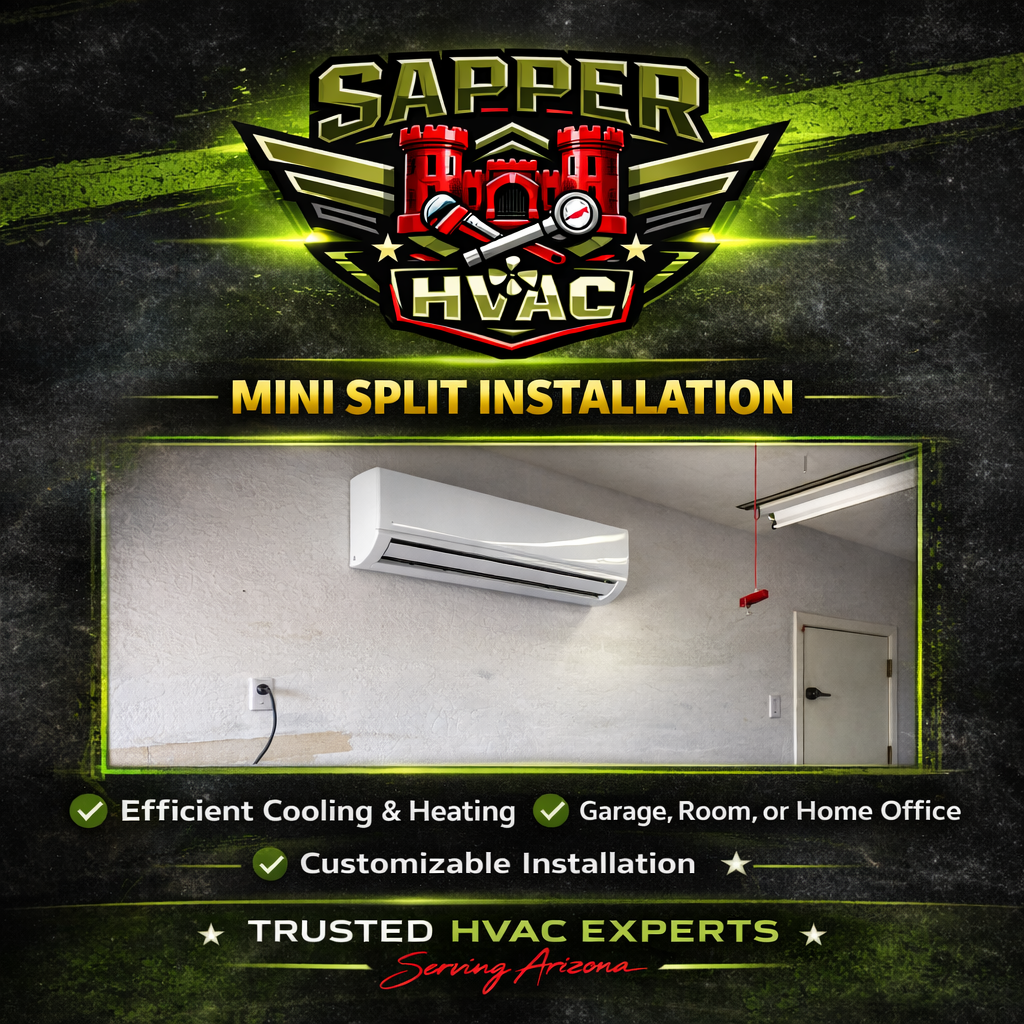
Ductless mini split installation in an Arizona garage — Sapper HVAC
Mini Split Installation Cost in Arizona
| Configuration | BTU / Capacity | Typical Installed Cost |
|---|---|---|
| Single zone — small room | 9,000–12,000 BTU | $2,500–$3,800 |
| Single zone — large room or garage | 18,000–24,000 BTU | $3,200–$4,800 |
| Single zone — large garage or casita | 30,000–36,000 BTU | $4,000–$6,000 |
| Multi-zone — 2 zones | 18,000–36,000 BTU total | $5,000–$8,000 |
| Multi-zone — 3 zones | 27,000–54,000 BTU total | $7,000–$11,000 |
| Multi-zone — 4 zones | 36,000–72,000 BTU total | $9,000–$14,000 |
All prices include equipment, electrical, conduit, line set, and installation. 2-year labor warranty included.
Is a Mini Split Worth It for an Arizona Garage?
Yes — almost universally. A standard garage in Arizona reaches 130 to 150 degrees on a summer afternoon. A properly sized mini split — typically 18,000 to 24,000 BTU for a two-car garage — maintains a comfortable temperature even during peak summer heat. The installed cost of $3,200 to $4,800 pays back quickly in usability.
Package Unit Replacement Cost in Arizona
Many Arizona homes built from the 1970s through the late 1990s use rooftop or side-yard package units. Here is what replacement costs in 2026.
Package Unit Replacement Cost in Arizona
| System Type | Capacity | Typical Installed Cost |
|---|---|---|
| Electric Package Unit | 2–3.5 ton | $4,500–$7,000 |
| Gas Package Unit | 2–3.5 ton | $5,000–$8,000 |
| Heat Pump Package Unit | 2–3.5 ton | $5,000–$8,500 |
| High-Efficiency Package Unit | 2–3.5 ton | Add $1,000–$2,500 |
The Most Important Thing — Get a Load Calculation
Every cost table in this guide is a starting point. The actual right system for your home depends on your home's specific cooling load.
A Manual J load calculation is the engineering analysis that determines exactly how much cooling capacity your home needs. It accounts for square footage, ceiling height, insulation levels, window area and orientation, local climate data, and internal heat sources.
In Arizona, sizing affects comfort, runtime, airflow, and equipment performance. Sapper HVAC reviews the home's load and installation conditions before recommending replacement capacity.
Red Flags to Watch Out for When Getting Quotes
No site visit or load calculation
Any contractor who quotes a system size over the phone without visiting your home is guessing.
Same tonnage as your old system without explanation
If a contractor recommends the exact same tonnage without asking about modifications or changes to the home, ask them to show you the load calculation.
Significantly lower price than other quotes
Below-market pricing almost always reflects below-market equipment, below-market installation, or both. The lowest quote in Arizona HVAC is frequently the most expensive one over the life of the system.
No mention of warranty
A reputable contractor will clearly state the equipment manufacturer warranty and their own labor warranty. Sapper HVAC provides a 2-year labor warranty on every installation.
No license number
All Arizona HVAC contractors are required to hold an ROC license. Sapper HVAC's license is ROC#360142. Verify any contractor at azroc.gov.
How to Get the Best Price on AC Replacement in Arizona
Schedule in the off-season
February–April and October–November are the best times. Contractors have more availability and jobs can be scheduled faster.
Ask about manufacturer rebates
Daikin, Carrier, Lennox, and Trane all run rebate programs. Your contractor should factor current rebate offers into your quote.
Ask about financing
Sapper HVAC offers financing for qualified customers. Spreading a $7,000 installation over 18–36 months is often more practical than depleting savings.
Get three quotes
Not to find the cheapest, but to find the best value. Compare system brand, tonnage, efficiency rating, warranty terms, and whether a load calculation was performed.
Do not wait for total failure
If your system is 12–15 years old and showing strain, replacing proactively gives you the ability to schedule in the off-season without emergency pricing pressure.

Sapper HVAC — honest diagnosis and correct installation every time
Frequently Asked Questions
About Sapper HVAC
Sapper HVAC
Veteran-Owned · Licensed ROC#360142 · Based in Chandler, AZ
Sapper HVAC is a veteran-owned, licensed, bonded, and insured Arizona HVAC contractor based in Chandler. We serve the Phoenix Metro with central AC replacement, heat pumps, package systems, mini splits, and HVAC repair. Replacement projects include a sizing and installation-scope review, and qualifying Sapper-installed systems include the company's standard 2-year labor warranty.
View all HVAC services →