
Written by: Sunny Bert
Lead HVAC Technician | 30 Years Experience
EPA 608 Certified (Type I & II) | AZ ROC License #360142 | Former Owner, Pueblo Mechanical
Direct Answer
For most Arizona homeowners, the answer is simple: replace like-for-like. If your home has a package unit (common in homes built before 2000), replace it with a package unit — $4,500–$8,500 installed. If it has a split system (standard in homes built after 2000), replace it with a split system — $5,500–$9,000 installed. Converting from one type to the other adds $2,000–$5,000 in extra work and rarely makes financial sense. What matters far more than system type is correct sizing via a Manual J load calculation.
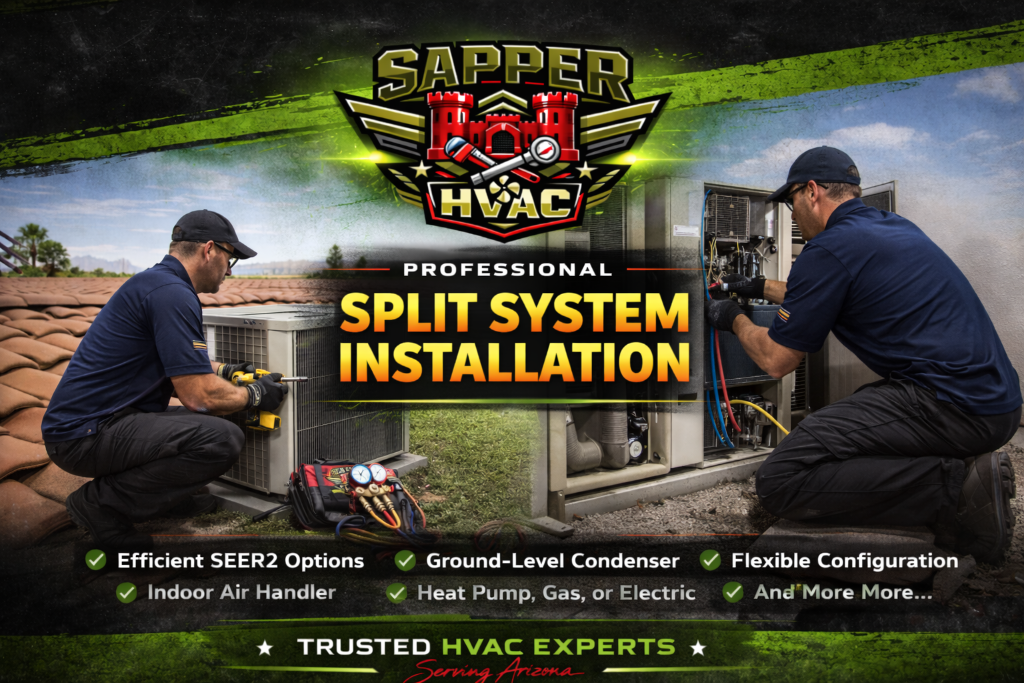
Split system installation in Arizona — Sapper HVAC, Chandler
How a Split System Works
A split system is exactly what the name suggests — the components are split between two locations.
The indoor unit (air handler) is typically installed in a utility closet, attic, or dedicated mechanical room inside the home. It contains the evaporator coil and the blower that circulates conditioned air through your ductwork. In a heat pump configuration, it also handles the heating function.
The outdoor unit (condenser) sits outside the home — usually on a concrete pad beside the house or behind it. It contains the compressor, condenser coil, and refrigerant connections. This is the unit that rejects heat to the outside air and the one you hear running during cooling operation.
The two units are connected by refrigerant lines that run through the wall or through the attic. In Arizona's heat, these line sets must be properly insulated to prevent heat gain that reduces system efficiency.
Where Split Systems Are Most Common in Arizona
Split systems are the standard in virtually all Arizona homes built after 2000. In the Phoenix Metro, they dominate in Gilbert, Queen Creek, San Tan Valley, north Scottsdale, and Chandler's newer southeast neighborhoods. They are also standard in most Maricopa and Casa Grande new construction.
How a Package Unit Works
A package unit — also called a packaged system or rooftop unit — combines everything into one cabinet: the evaporator, condenser, compressor, and blower are all housed together and installed in a single outdoor location.
In Arizona residential applications, package units are most commonly installed in one of two ways:
Rooftop installation: The unit sits on the roof with ductwork connections running through the ceiling. This is extremely common in homes with flat or low-slope roofs — a very common roof style in Arizona.
Ground-level side-yard installation: The unit sits beside the home on a concrete pad, with ductwork connections running through the exterior wall.
Because everything is in one cabinet, there is no indoor air handler, no refrigerant lines running through the home, and no dedicated indoor mechanical space required. The simplicity of this configuration is why it became the standard for a large portion of Arizona residential construction in the mid-20th century.
Package unit installation — Sapper HVAC serves all Phoenix Metro cities
Where Package Units Are Most Common in Arizona
Package units are most prevalent in Arizona homes built from the 1960s through the early 1990s. They are heavily concentrated in:
West Valley cities: Sun City, Sun City West, Glendale, older Peoria, El Mirage, Tolleson, Avondale, and Goodyear's older residential stock.
East Valley older neighborhoods: Central and west Mesa, older Tempe, parts of Chandler's historic core, and Apache Junction's older housing stock.
Rural and outlying communities: Florence, Casa Grande, older Wickenburg properties, and older manufactured home communities throughout the Valley.
Split System vs. Package Unit — Side by Side Comparison
Efficiency — Is One Better Than the Other?
This is the question most Arizona homeowners ask first. The honest answer: in modern equipment, not by much.
The Old Efficiency Gap Is Largely Gone
Historically, split systems were considered more efficient than package units. That gap was real in equipment manufactured through the 1990s and early 2000s. Modern package units have closed it significantly. Today, both system types are available in SEER2 ratings from the minimum (SEER2 14 in Arizona) through high-efficiency (SEER2 20+). Daikin, Carrier, Lennox, and Trane all offer high-efficiency package unit lines that compete directly with their split system equivalents.
What Actually Drives Real-World Efficiency in Arizona
Proper sizing: An oversized or undersized system — regardless of its efficiency rating — will perform below its rated efficiency. A properly sized SEER2 14 system will outperform an improperly sized SEER2 20 system in real-world operation.
Refrigerant charge: Improper refrigerant charge is one of the most common installation mistakes in Arizona. A system with incorrect refrigerant charge can lose 20 to 30 percent of its rated efficiency. This applies equally to both system types.
Duct condition: Leaky, undersized, or poorly insulated ductwork is one of the biggest sources of efficiency loss in any Arizona HVAC system. Studies consistently show the average Arizona home loses 20 to 30 percent of conditioned air through duct leakage.
The efficiency debate between split systems and package units is largely resolved in modern equipment. If you are replacing a package unit in a home designed for one, replacing like-for-like with a properly sized, correctly installed package unit is almost always the right decision. The efficiency difference does not justify the cost and disruption of converting to a split system.
Cost Comparison — Split System vs. Package Unit
Installed Cost Comparison (2026, Phoenix Metro, 2.5–3.5 ton)
| System Type | Standard Efficiency (SEER2 14–16) | High Efficiency (SEER2 18+) |
|---|---|---|
| Split System | $5,500–$9,000 | $7,500–$13,000 |
| Gas Package Unit | $5,000–$8,000 | $6,500–$10,500 |
| Electric Package Unit | $4,500–$7,500 | $6,000–$9,500 |
| Heat Pump Package Unit | $5,000–$8,500 | $6,500–$11,000 |
| Converting Package → Split | Add $2,000–$5,000+ | Add $2,000–$5,000+ |
These ranges reflect complete installed costs including equipment, labor, and startup. Ductwork modifications, electrical upgrades, and structural work are additional.
The Cost of Converting From Package Unit to Split System
The most common question we get from package unit homeowners is whether they should convert to a split system when their package unit fails. In most cases, the answer is no — and the math explains why.
A like-for-like package unit replacement typically costs $4,500 to $8,500 installed. Converting to a split system involves:
- Creating an indoor air handler location (attic framing, electrical, drain line)
- Running refrigerant line sets through the structure
- Modifying ductwork connections at both locations
- Potentially upgrading electrical service
This typically adds $2,000 to $5,000 to the project cost. For most Arizona homeowners, the conversion does not pencil out compared to a well-selected package unit replacement.
Lifespan — How Long Does Each System Last in Arizona?
Both system types have similar expected lifespans under Arizona conditions when properly sized and maintained.
Expected Lifespan in Arizona
| System Type | Expected Lifespan (AZ) | National Average |
|---|---|---|
| Split System (correctly sized + installed) | 13–17 years | 15–20 years |
| Package Unit (correctly sized + installed) | 12–16 years | 14–18 years |
| Either system (undersized or poor install) | 7–10 years | N/A |
The gap between Arizona and national lifespan reflects the reality of running a system 7 to 8 months per year in temperatures that regularly exceed 110 degrees. Both system types experience this equally. What drives lifespan differences between specific installations is almost entirely sizing accuracy and installation quality — not system type.
Which System Is Right for Your Arizona Home?
The decision tree is straightforward for most Arizona homeowners.
If Your Home Currently Has a Package Unit
Replace it with a package unit. Unless you have a compelling reason to convert — a major renovation project, a problematic rooftop location, or a specific need for a system type only available as a split — a like-for-like replacement is almost always the right call. It is less expensive, less disruptive, faster to install, and performs comparably in modern equipment. The only mandatory step is ensuring the replacement is properly sized via a Manual J load calculation.
If Your Home Currently Has a Split System
Replace it with a split system. Your home already has the indoor air handler infrastructure and refrigerant line routing — replacing like-for-like uses what is already there. Again: proper sizing via Manual J is mandatory.
If You Are Building or Doing a Major Renovation
For new construction or gut renovation, split systems are almost universally recommended. The wider product selection, higher available efficiency ratings, and protected indoor components make split systems the better long-term choice when you have the flexibility to install either. The one exception: flat or low-slope roof designs where rooftop package unit installation is architecturally natural.
Not Sure Which System Your Home Has — or Which One You Need?
Sapper HVAC is based in Chandler and serves the entire Phoenix Metro. We will assess your home, run a proper load calculation, and give you a clear recommendation — with no pressure and no upsell. Free quote, follows up during business hours.
Get a Free AssessmentOr call (602) 206-7359 · Licensed ROC#360142 · Veteran-Owned
Maintenance — Does One System Require More Work?
Both split systems and package units require the same basic annual maintenance: filter replacement, coil cleaning, refrigerant level check, electrical connection inspection, and blower cleaning. The difference is where that maintenance happens.
Split System Maintenance Access
Split systems require accessing two locations: the outdoor condenser (easy — ground level) and the indoor air handler (attic, closet, or utility room). Attic air handler access in Arizona is particularly important because attic temperatures can exceed 150 degrees in summer — maintenance should be done in spring or fall, not July.
Package Unit Maintenance Access
Package units are all in one location — rooftop or ground-level side-yard. Ground-level package units are the easiest of all configurations to access. Rooftop package units require roof access and it is worth having a technician verify rooftop curb and flashing condition during each maintenance visit.
Arizona-Specific Maintenance Priorities for Both Systems
Coil cleaning
Arizona's dust accumulates on condenser coils faster than in most climates. Dirty coils reduce efficiency and can cause overheating. Annual coil cleaning is minimum — twice per year is better for homes near dusty terrain.
Refrigerant charge verification
Heat causes refrigerant lines to expand and contract, which can accelerate slow leaks over time. Annual verification catches small leaks before they become failures.
Filter replacement
Arizona's dust means filters clog faster than national recommendations suggest. Check monthly during peak season (June–September) and replace whenever visibly dirty.
Sapper HVAC — honest assessment, proper sizing, correct installation every time
The Bottom Line — Split System vs. Package Unit in Arizona
The split system versus package unit debate is largely settled by what your home was built for. Most Arizona homeowners will replace like-for-like and that is the right answer in most cases. What matters far more than the system type:
Proper sizing
Always demand a Manual J load calculation before a system is recommended. An incorrectly sized system — regardless of type, brand, or efficiency rating — will underperform and fail early in Arizona's climate.
Quality installation
Proper refrigerant charge, correct airflow, quality electrical connections, and properly sealed ductwork matter more than the system type in determining real-world performance and lifespan.
Reputable contractor
An Arizona ROC-licensed contractor who performs load calculations, stands behind their work with a meaningful warranty, and gives you honest repair vs. replace guidance is worth more than the cheapest quote.
Frequently Asked Questions
About Sapper HVAC
Sapper HVAC
Veteran-Owned · Licensed ROC#360142 · Based in Chandler, AZ
Sapper HVAC is a veteran-owned, licensed HVAC company based in Chandler. Our technicians bring 30+ years of combined team HVAC experience to every job — installing split systems, package units, and ductless mini splits across the entire Phoenix Metro. Every installation includes a Manual J load calculation and is backed by a 2-year labor warranty. Arizona ROC#360142.
View all HVAC services →