Quick Answer
A clogged AC drain line in Phoenix shows up as a brown ceiling stain, water dripping near your air handler, water running from a pipe above a window, or an AC that shuts off without warning. Algae, attic dust, and insect nests cause most clogs. Turn the system off at the thermostat, check for water, and call a licensed HVAC tech before the water soaks into drywall.
What does an AC drain line do?
Your AC drain line carries water away from your air conditioner. As warm indoor air passes over the cold evaporator coil, moisture in the air turns into water. That water drips into a drain pan and flows out through a PVC pipe called the condensate line.
In most Phoenix homes, that line runs from the air handler in the attic or a hall closet to the outside wall, the roof edge, or a plumbing drain. When the line works, you never think about it. When it clogs, the water has nowhere to go but back into your home.
What are the warning signs of a clogged AC drain line?
The top warning signs are water stains on the ceiling, water dripping from a pipe above a window, and an AC that shuts off on its own. Catch any of these early and you can stop the damage before it spreads.
Watch for these signs in your Phoenix home:
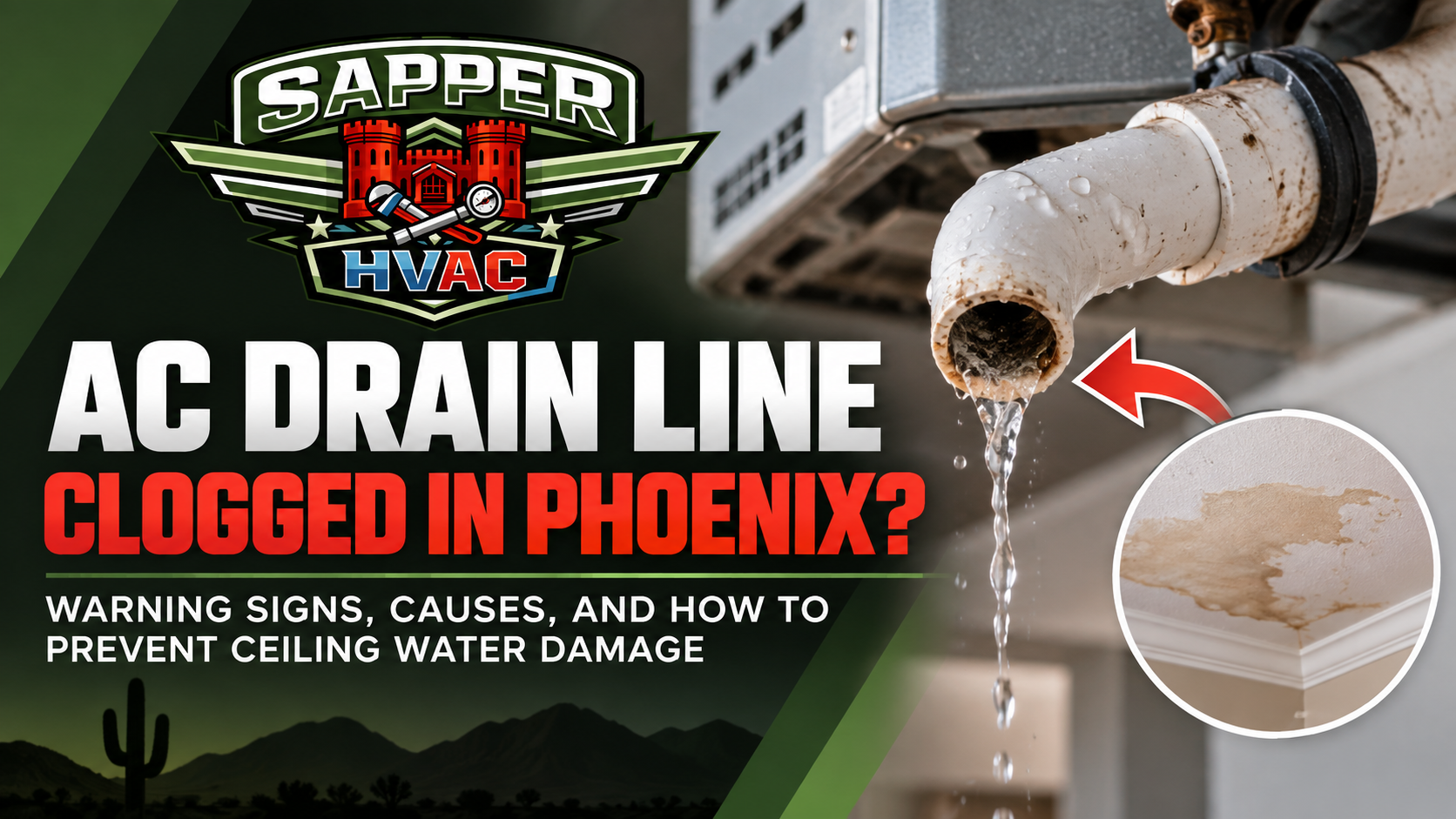
- A brown or yellow stain on the ceiling below the attic air handler or near a ceiling return vent.
- Water dripping from a small pipe above a window or on the eave. This is your secondary drain line. Builders place it there so you notice it. Water here means the main line is blocked.
- Your AC shuts off and will not restart. Many systems have a float switch that kills the cooling when water backs up. It protects your ceiling, but it leaves you with no AC.
- Water around the indoor unit in a closet, garage, or utility room.
- A musty or mildew smell coming from the vents.
- Standing water in the drain pan when you look at the air handler.
- The house feels sticky even though the AC runs.
If you see one of these signs, treat it as a repair call, not a wait and see issue.
Why do AC drain lines clog in Phoenix homes?
Heat, dust, and monsoon humidity cause most drain line clogs in the Valley. Phoenix conditions create the perfect setup for slime and debris to build inside a small pipe.
Here is what we find inside clogged lines across Phoenix, Mesa, Glendale, Chandler, and the West Valley:
- Algae and slime buildup. Attic temperatures in Phoenix pass 140 degrees in summer. Warm, wet, dark pipes grow algae and bacteria that form a thick gel.
- Dust from haboobs and attic insulation. Fine desert dust pulls into the return air, sticks to the wet coil, and washes into the drain pan as sludge.
- Monsoon humidity. From July through September your AC pulls far more water out of the air than it does in dry June. More water through a dirty line means faster clogs and overflows.
- Insects and mud daubers. Wasps, spiders, and mud daubers build nests inside the open end of the line outside your home.
- Poor slope or sagging pipe. A drain line needs a steady downhill slope. Lines that sag in the attic hold water and trap debris.
- Dirty air filters. A clogged filter lets more dust reach the coil, and that dust ends up in the drain.
Why is a clogged drain line worse when the air handler is in the attic?
An attic air handler sits right above your drywall, so any overflow drips onto your ceiling. A closet or garage unit leaks onto a floor you can see. An attic unit leaks where you cannot see it until a stain appears.
Most Phoenix homes built from the 1980s on put the air handler in the attic. Water from a blocked line soaks the insulation first, then the drywall. By the time a stain shows on your ceiling, the drywall may hold gallons of water. Wet drywall can sag, grow mold, and fall.
A working secondary drain pan and float switch give you a second layer of protection. Many older Phoenix homes have a rusted pan, a pan with no switch, or a switch that no one has tested in years.
What should you do right now if your AC is leaking water?
Turn off the AC at the thermostat first. This stops new water from forming while you check the damage.
Then follow these steps:
- Turn the thermostat to OFF. Leave the fan off too.
- Turn off power to any ceiling lights or fans near a wet spot. Water and wiring do not mix.
- Place towels and a bucket under the leak. If the ceiling sags or bulges, keep people and pets out of the room.
- Check the secondary drain outlet above a window or on the eave. Water there confirms a main line clog.
- Replace the air filter if it looks gray or clogged.
- Call a licensed HVAC company. In a Phoenix summer, a house without AC heats up fast. Kids, older adults, and pets face real heat risk.
What should you NOT do when your AC drain line clogs?
Do not bypass the float switch, pour harsh drain cleaner down the line, or keep running a leaking system. These shortcuts turn a simple drain service into coil, pan, or ceiling repairs.
| Mistake | Why it causes problems |
|---|---|
| Bypassing or unplugging the float switch | Your AC runs again, but the water overflows into your ceiling |
| Pouring chemical drain cleaner down the line | Harsh chemicals can damage PVC glue joints, metal pans, and the coil |
| Using bleach without checking your manual | Some manufacturers do not allow bleach in the drain system |
| Running the AC while water pools | Every hour of runtime adds more water to the leak |
| Forcing a wire or snake into the line | You can crack the pipe or push the clog deeper |
| Painting over a ceiling stain | The stain hides a wet spot that can still grow mold |
| Ignoring water from the secondary drain | That drip is your warning. The main line is already blocked |
How do you prevent a clogged AC drain line?
Schedule a professional drain line flush and float switch test at every AC tune-up. Pair that with simple checks at home and most clogs never happen.
Steps that keep your drain line clear:
- Book a tune-up twice a year, once in spring before the heat and once in fall after monsoon season.
- Change your air filter every 1 to 3 months. Phoenix dust fills filters faster than most other cities.
- Check the outside drain outlet each month in summer. You should see a slow drip when the AC runs. No drip on a humid day can mean a clog.
- Look for water above your windows after monsoon storms and on humid days.
- Ask your tech to add a cleanout tee if your line has no access port. It makes flushing fast and clean.
- Test the float switch during each tune-up so you know it will shut off the system before water hits your ceiling.
- Check with your equipment manual before you pour anything into the line. Some systems allow a cup of distilled white vinegar through the cleanout. Others do not.
For the full seasonal playbook, read our Phoenix heat wave AC checklist. A Sapper HVAC maintenance plan includes drain line flushing and float switch testing at each visit, so you never have to remember it.
When should Phoenix homeowners call an HVAC professional?
Call a pro the moment you see a ceiling stain, water from the secondary drain, or an AC that shuts off and will not restart. These signs mean the clog is past a simple home fix.
Call Sapper HVAC if:
- Water drips from your ceiling or a ceiling vent
- The float switch tripped and your AC will not run
- The drain line clogs again within a few weeks of clearing it
- You smell mildew from the vents
- The drain pan shows rust or cracks
- You cannot find where your drain line exits the house
- Your AC also struggles to cool (see why your AC cannot get below 80 degrees)
A repeat clog often points to a bigger issue, such as a pipe with no slope, a cracked pan, or a frozen coil that sends extra water into the drain. If the house stays warm while the leak continues, read about the 20 degree rule before you assume the thermostat is the problem. For broader cooling trouble, see our guide to AC repair in Phoenix.
How does Sapper HVAC fix a clogged AC drain line?
Our techs clear the clog, flush the line, test the float switch, and find the reason the line clogged in the first place. You get a clear drain and a plan to keep it that way.
Here is what a Sapper HVAC drain line service covers:
- Inspect the air handler, drain pan, and secondary pan for water, rust, and cracks.
- Clear the clog from the drain line and trap.
- Flush the line so algae and sludge leave the system.
- Test the float switch to confirm it shuts off cooling when water rises.
- Check the slope and supports on the drain line in the attic.
- Check the coil and filter for dirt that feeds future clogs.
- Recommend fixes such as a cleanout tee, a new pan, or a new switch, with the price up front before any work. A rusted pan past repair is one sign you may need full AC replacement.
Sapper HVAC is a veteran-owned, authorized Daikin dealer serving homeowners across the Phoenix Valley. Arizona ROC 360142.
Frequently Asked Questions About Clogged AC Drain Lines in Phoenix
Can a clogged AC drain line cause ceiling damage?+
Yes. In Phoenix homes with attic air handlers, a clogged drain line overflows onto the insulation and drywall. Water can stain, sag, and grow mold in the ceiling before you notice a leak.
Why did my AC shut off when the drain line clogged?+
Your system has a float switch or safety switch. When water backs up in the drain pan, the switch cuts power to the cooling so the pan does not overflow. Clearing the clog and resetting the switch gets your AC running again.
Why is water dripping from a pipe above my window?+
That pipe is your secondary drain line. Builders route it above a window so you see it. Water there means your main drain line is clogged and needs service.
How often should an AC drain line get flushed in Phoenix?+
Have a pro flush the line at each tune-up, twice a year. Check the outside drain outlet each month during summer and after monsoon storms.
Is a clogged AC drain line an emergency in Phoenix?+
It becomes one when water drips through your ceiling or the float switch shuts off your AC during extreme heat. Turn the system off to stop the leak and call for same-day service.
Does monsoon season make drain line clogs worse?+
Yes. Monsoon humidity makes your AC pull more water from the air. More water flowing through a line with algae or dust leads to faster backups and overflows.
Can I use vinegar to clean my AC drain line?+
Check your equipment manual first. Some manufacturers allow a cup of distilled white vinegar through the cleanout port. A pro flush clears buildup that vinegar cannot reach.
AC Drain Line Service
Water on Your Ceiling? Stop the Leak Today.
Sapper HVAC clears clogged drain lines, tests your float switch, and finds the cause so the leak does not come back. Veteran-owned. Authorized Daikin dealer. Serving the Phoenix Valley. Ask about our financing options.