

Is a 3 ton central air unit right for your Phoenix-area home? Learn sizing, airflow, SEER2, costs, ductwork, and what a proper quote should include.
A 3 ton central air unit delivers 36,000 BTU per hour and is typically matched to roughly 1,500 to 2,100 square feet. In Phoenix, though, the practical range often moves downward because extreme heat, attic exposure, windows, and duct losses raise the cooling load.
A 3 ton system may be exactly right for your home. It may also be too large or too small. The honest answer comes from the home's heat load, ductwork, airflow, and equipment match, not from a square-footage chart alone.
What a 3 Ton Central Air Unit Means
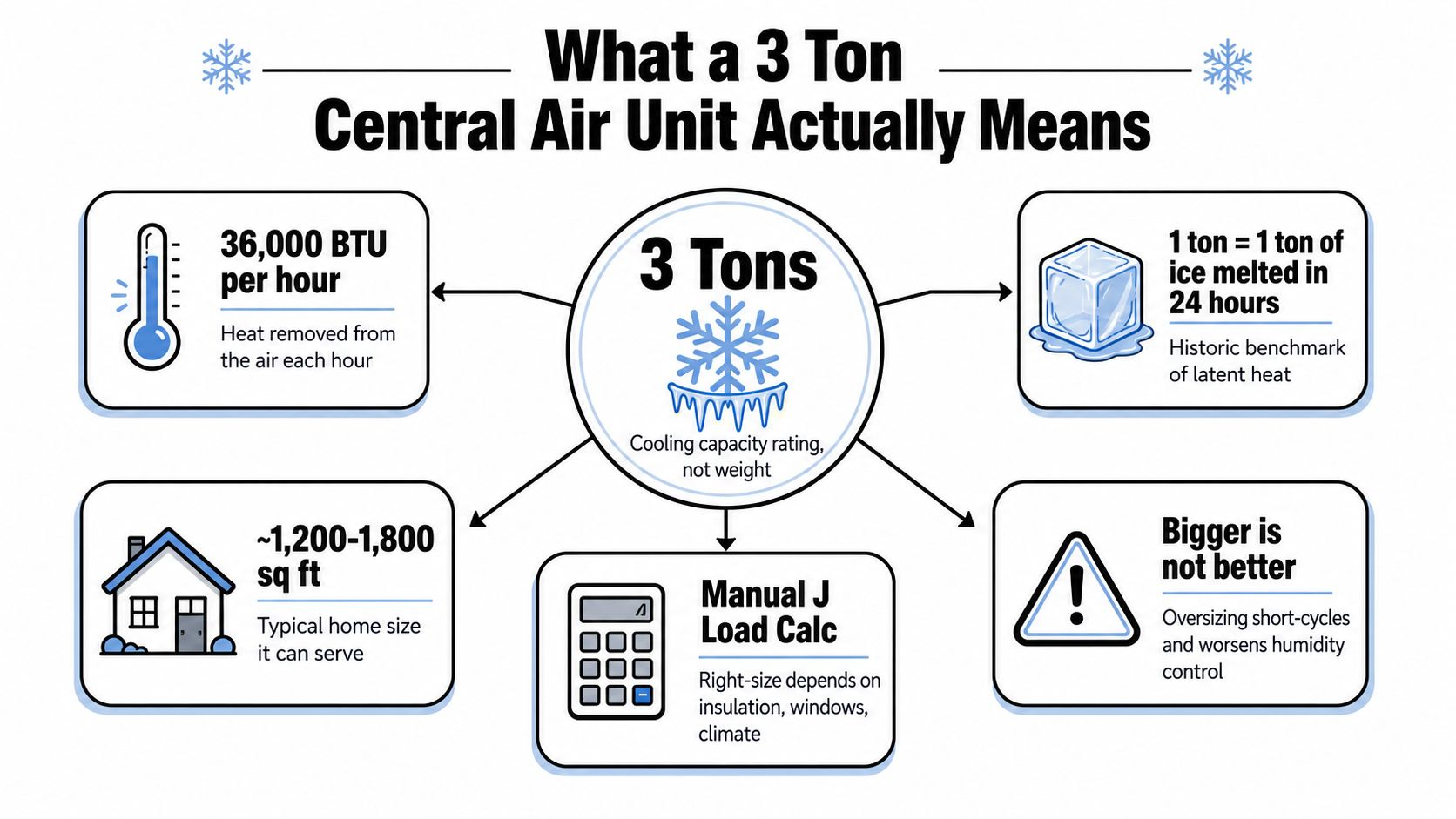
A 3 ton central air unit does not weigh three tons. The word “ton” describes cooling capacity, not physical weight. One ton of air-conditioning capacity equals 12,000 BTU per hour, so three tons equals 36,000 BTU per hour of heat removal.
A typical central system includes an outdoor condenser, indoor evaporator coil or air handler, refrigerant line set, and thermostat. In Chandler and the Phoenix Metro, tonnage is only the starting point. Attic exposure, duct leakage, airflow, static pressure, and the indoor/outdoor equipment match all affect real-world performance.
The equipment must work as a matched system
The outdoor condenser, indoor coil, blower, refrigerant metering device, and thermostat need to operate together. Pairing a high-efficiency condenser with the wrong coil, undersized ducts, or excessive static pressure can reduce airflow and leave rooms hot.
Airflow matters as much as nominal tonnage. A common design reference is about 400 CFM per ton, placing a 3 ton system near 1,200 CFM, although actual airflow targets vary by equipment and duct conditions.
For a permanent home installation, begin with a written load calculation, then verify duct capacity and equipment compatibility. A nameplate-based replacement is not a sizing method.
Sizing a 3 Ton System for Phoenix-Area Homes
The national starting point for a 3 ton system is often around 1,500 to 2,100 square feet, depending on climate, insulation, windows, and layout. Other commonly used charts narrow that estimate to roughly 1,500 to 1,800 square feet in moderate conditions.
Phoenix Metro is not a moderate-climate test case. Homes in Chandler, Gilbert, Mesa, and surrounding areas face extreme summer heat, hot attic conditions, heavy afternoon solar gain, and long cooling seasons.
Why Phoenix square footage can mislead you
A 3 ton system that works in a tightly built home elsewhere may struggle in Chandler. The load calculation should account for:
- Roof and attic exposure, especially with dark roofing or weak attic insulation.
- West-facing windows and severe afternoon solar load.
- Two-story layouts where upper floors gain heat faster.
- Ceiling height and open floor plans.
- Duct leakage and static pressure, especially where ducts run through hot attics.
- Insulation quality, window performance, and home orientation.
Oversizing is not a harmless mistake. A system that is too large can satisfy the thermostat quickly, shut off, and create uneven temperatures. Undersizing creates the opposite problem, with long runtimes and weak recovery during the hottest part of the day.
| Home Profile | 3 Ton Fit | Notes |
|---|---|---|
| Tight, shaded, well-insulated home | May be more than enough | Lower load can support smaller equipment. |
| Typical East Valley single-story home | Often a reasonable range | Confirm load, airflow, and ducts before selecting. |
| West-facing home with attic heat | Lower practical coverage | Solar gain can raise the cooling load significantly. |
| Two-story home with high ceilings | Area alone is not enough | Room-by-room loads, return air, and zoning matter. |
For a more specific local example, review Sapper HVAC's Phoenix AC sizing guide for a 2,000-square-foot home.
SEER2 Efficiency and Long-Term Operating Cost
A 3 ton label tells you cooling capacity, not efficiency. SEER2 measures seasonal performance and helps compare matched systems before you compare quotes.
SEER2 will not predict your exact electric bill. Thermostat settings, insulation, duct leakage, indoor airflow, outdoor temperature, utility rates, and runtime all matter. Phoenix heat exposes weak duct design and restricted airflow quickly.
How to compare efficiency tiers
| SEER2 Tier | Operating Pattern | Typical Upfront Position |
|---|---|---|
| Lower efficiency | Higher relative electricity use | Usually lower initial equipment cost |
| Mid-range efficiency | Balanced electricity use | Practical choice for many Phoenix homes |
| Premium efficiency | Lower relative use when properly matched | Higher initial cost and greater complexity |
Higher-efficiency equipment may require a compatible air handler, variable-speed blower, communicating controls, and duct corrections. Ask the contractor to verify airflow and static pressure before paying extra for a premium rating.
Practical rule: Choose SEER2 after reviewing matched equipment, duct condition, expected ownership period, refrigerant platform, and installation quality. The highest number is not automatically the best value.
Installed Cost, Ductwork, and a Realistic Budget
There is not one honest price for a 3 ton installation in the East Valley. The final proposal depends on equipment efficiency, indoor coil or air handler, electrical work, refrigerant piping, condensate routing, attic access, permits, and duct condition.
A low quote may leave out work another contractor includes. Compare the scope line by line, especially if one proposal includes only an outdoor condenser while another includes a matched indoor coil, testing, startup, and duct corrections.
What belongs in the proposal
- Equipment: Condenser, indoor coil or air handler, thermostat, and matched efficiency.
- Installation labor: Removal, placement, brazing, evacuation, charging, startup, and cleanup.
- Refrigerant piping: Reuse or replacement of the line set, with insulation condition noted.
- Electrical work: Disconnect, wiring, breaker, and panel capacity where applicable.
- Condensate management: Drain routing, safety controls, and future service access.
- Ductwork: Sealing, return-air changes, supply modifications, or static-pressure corrections.
- Permits and warranty: Included paperwork, manufacturer coverage, and labor terms.
Homes built before 2000 in Chandler, Gilbert, and Mesa often deserve a duct inspection before equipment selection. Replacing a condenser without fixing restricted or leaking ductwork can be a poor investment.
How a 3 Ton Compares to 2.5 and 4 Ton Units
Consider a representative 1,800-square-foot Phoenix home with west-facing exposure and a hot attic. A 3 ton system might be a balanced fit, but the actual load could justify a 2.5 ton system after insulation and duct improvements, or a 4 ton system if the windows, layout, and heat gain are severe.
A 2.5 ton system can be the better choice when the home is tight, ducts are sealed, and the calculated load is smaller. A 4 ton system can be justified by verified heat gain, but it is not justified merely because the homeowner wants the house to cool faster.
| Option | When It Makes Sense | Main Risk |
|---|---|---|
| 2.5 ton | Smaller calculated load, tight envelope, good ductwork | May not handle verified Phoenix heat gain |
| 3 ton | Load calculation lands near system capacity | Wrong if chosen from area alone |
| 4 ton | Large windows, additions, severe attic load, higher calculated demand | Short cycling if oversized |
A contractor who recommends a 4 ton unit without showing the load calculation is guessing. The same applies to a 2.5 or 3 ton recommendation.
Installation Quality and Ongoing Maintenance
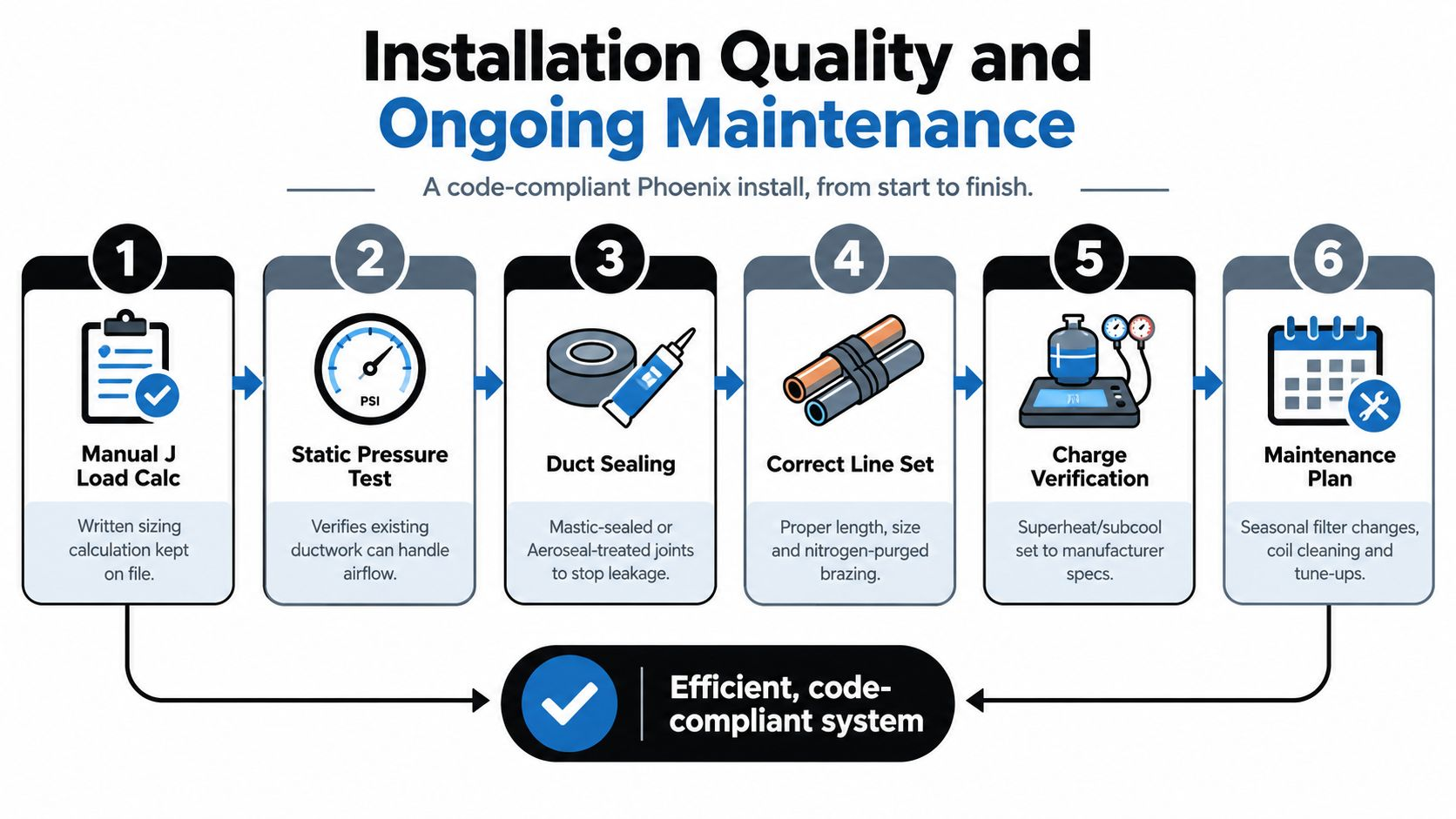
Good equipment cannot overcome careless installation. In Phoenix, a proper installation starts before the old condenser is removed.
What a quality installation includes
- Load calculation: Documents why the selected capacity fits the home.
- Static-pressure testing: Shows whether the duct system can move the required air.
- Duct sealing: Appropriate sealing reduces leakage.
- Correct line-set work: Refrigerant piping must be properly sized, insulated, and joined.
- Pressure testing and evacuation: The installer verifies the system before final startup.
- Measured commissioning: Airflow, temperature performance, refrigerant charge, and controls receive documented checks.
Nominal airflow around 1,200 CFM is a common reference for a 3 ton system, but actual targets can vary. The supplied article describes a broader range of roughly 975 to 1,350 CFM depending on equipment, climate, and operating goals.
Maintenance should include filter attention, coil cleaning, electrical inspection, condensate-drain service, and attic duct inspection. Phoenix dust and heat are hard on coils, capacitors, insulation, and compressors.
Refrigerant Changes, Heat Pumps, and the Repair vs Replace Call
The refrigerant transition changes the replacement conversation. The supplied guide explains that homeowners should evaluate system condition, refrigerant situation, efficiency, repair history, and expected remaining service life before authorizing a major repair.
- Repair: When the equipment is relatively young, the failure is isolated, and the repair restores dependable operation.
- Replace with straight cooling: When conventional air conditioning fits the home and the existing indoor equipment remains compatible.
- Consider a heat pump: When electrification, year-round heating, or variable-capacity comfort is important.
- Review rebates carefully: APS and SRP programs can change, and eligibility depends on equipment and documentation.
The supplied article also states that homeowners should not count on the prior Section 25C HVAC credit for equipment placed in service after December 31, 2025.
Getting an Honest Local Quote from Sapper HVAC
Before calling a contractor, gather the approximate conditioned square footage, year built, current system age and model, recent utility bills, and a list of comfort complaints. Note rooms that stay hot, noisy returns, weak registers, attic duct concerns, and whether the system freezes or runs constantly.
A serious quote should include:
- A load calculation rather than a square-footage guess.
- A static-pressure test on the existing ductwork.
- A duct-sealing and return-air assessment.
- An electrical panel and disconnect review.
- A written proposal separating equipment, labor, ductwork, electrical work, permits, and warranty terms.
- A clear explanation of the refrigerant and matched indoor equipment.
Sapper HVAC is veteran-owned, licensed, bonded, and insured, carries ROC #360142, and is based at 6505 W Frye Rd, Ste 21, Chandler, AZ 85226.
For scheduling, call (602) 206-7359 or email [email protected].
Common Questions About 3 Ton Systems
Is a 3 ton system enough for a Phoenix home?
It can be, especially when the load calculation supports it and the ducts, insulation, windows, and airflow are in good condition.
How much airflow does a 3 ton unit need?
A common reference is about 400 CFM per ton, or approximately 1,200 CFM for a 3 ton system, though actual targets depend on the equipment and duct pressure.
Is a larger air conditioner better?
No. An oversized system can short-cycle and create uneven temperatures. Select the capacity that matches the calculated load.
Should I replace an older R-410A system?
Not automatically. Compare the repair, refrigerant situation, operating efficiency, equipment condition, and replacement options before deciding.
What should a contractor prove before installing a 3 ton central air unit?
The contractor should show how the load supports the capacity, how the ducts will deliver the required airflow, which indoor and outdoor components are matched, and how the completed system will be tested.
Get a Right-Sized 3 Ton AC Quote in Phoenix
If your Chandler or East Valley home is being quoted for a 3 ton central air unit, schedule a measured assessment instead of accepting a square-footage guess.
Request an estimate from Sapper HVAC or call (602) 206-7359.