
Quick Answer
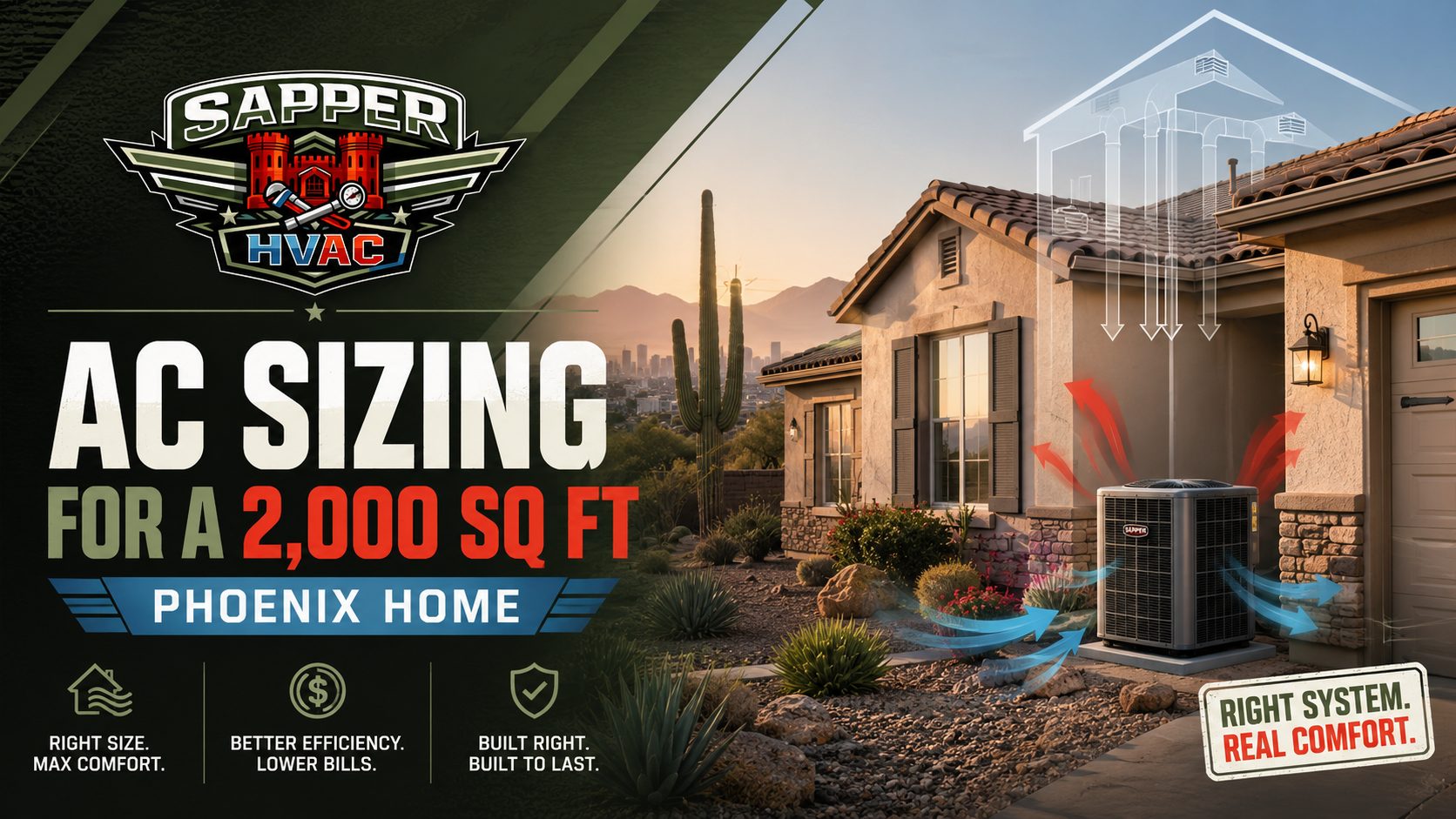
A 2,000 square foot house in Phoenix needs 4 to 5 tons of air conditioning in most cases, or 48,000 to 60,000 BTU. Desert homes need more cooling per square foot than homes in mild climates because of roof heat gain, long run times, and outdoor design temperatures above 110 degrees. Square footage alone does not set the final number. A Manual J load calculation accounts for insulation, window area, ceiling height, sun exposure, and duct condition, and that calculation decides the tonnage that will hold your setpoint in July. Book a free load calculation with Sapper HVAC.
How many tons of AC do you need per square foot in Phoenix?
Phoenix homes need one ton of cooling for every 400 to 500 square feet. Mild climate guidance puts that number at 600 square feet per ton. The desert changes the math.
Three things drive the difference:
- Design temperature. Phoenix cooling design sits near 110 degrees. A system sized for a 95 degree day runs out of capacity at 115.
- Roof and attic gain. Flat and low slope roofs absorb sun for twelve hours. Attic temperatures pass 150 degrees in July, and most Valley homes run ductwork through that attic.
- Run time. A Phoenix system runs almost around the clock from June through September. Capacity that looks fine in May falls short in monsoon season.
Use this chart as a starting range. It reflects standard Valley construction with an attic and dual pane windows.
| Home size | Cooling load | Tonnage range | BTU range |
|---|---|---|---|
| 1,000 sq ft | Light | 2 to 2.5 tons | 24,000 to 30,000 |
| 1,200 sq ft | Light | 2.5 to 3 tons | 30,000 to 36,000 |
| 1,500 sq ft | Moderate | 3 to 3.5 tons | 36,000 to 42,000 |
| 1,800 sq ft | Moderate | 3.5 to 4 tons | 42,000 to 48,000 |
| 2,000 sq ft | Moderate | 4 to 5 tons | 48,000 to 60,000 |
| 2,400 sq ft | Heavy | 5 to 6 tons | 60,000 to 72,000 |
| 3,000 sq ft | Heavy | 6 to 7.5 tons | 72,000 to 90,000 |
| 3,500 sq ft and up | Heavy | Two systems in most cases | Zoned by floor or wing |
Homes above 3,000 square feet often run two systems instead of one large unit. Two systems give you zoning, and they keep a single failure from shutting down the whole house in August.
Why does the same square footage need different tonnage?
Two 2,000 square foot homes on the same street can land two full tons apart. Square footage sets the starting range. These factors move it.
| Factor | Pushes size down | Pushes size up |
|---|---|---|
| Build year | 2005 and newer | Pre 1990 |
| Insulation | R-38 or better in the attic | R-19 or unknown |
| Windows | Dual pane, low E, sun screens | Single pane, west facing glass |
| Ceilings | 8 foot flat | Vaulted or 10 foot and up |
| Shade | Mature trees, north exposure | Full sun, no shade, dark roof |
| Ductwork | Sealed, insulated, in conditioned space | Leaking attic duct, crushed runs |
| Occupancy | Two people, seasonal | Six people, home all day |
| Heat load | Standard kitchen | Home office stack, gym, wine room, west sunroom |
An older Phoenix home with single pane glass and R-19 attic insulation can need 5 tons at 2,000 square feet. A 2018 build with sealed ducts and sun screens can hold the same house at 4 tons and run at a lower cost every month.
What is a Manual J load calculation and do you need one?
A Manual J load calculation measures the heat your house gains on a design day and converts it to a BTU number. It is the industry standard, and Arizona code references it for new equipment.
The calculation looks at:
- Exterior wall area, orientation, and construction
- Window count, glass type, and direction each window faces
- Attic insulation depth and roof color
- Duct location, duct leakage, and register count
- Ceiling height and volume
- Number of people in the house and heat producing equipment
The output is a load in BTU. That load points at a tonnage, and the tonnage points at equipment. A contractor who quotes tonnage from a drive by, or who matches whatever is sitting on the pad now, is guessing. The unit on your pad might have been wrong for fifteen years.
Sapper HVAC runs a load calculation before every replacement quote. Book a free load calculation.
What happens if the AC unit is too big for the house?
An oversized unit costs more, wears out sooner, and cools worse. Homeowners hear "bigger is better" and buy a problem.
Here is what oversizing does in a Phoenix home:
- Short cycling. The unit hits setpoint in a few minutes, shuts off, and restarts. Compressor starts cause most of the wear on the system.
- Humidity stays in the house. Air conditioners pull moisture out during long run cycles. Short cycles skip that step. During monsoon, an oversized house feels clammy at 74 degrees while a right sized house feels dry at 76.
- Hot and cold rooms. Fast cycles never move enough air to reach the far bedrooms. The thermostat hallway sits at 75 and the back room sits at 82.
- Higher bills. Startup draws the highest amperage of any part of the cycle. More starts mean more kilowatt hours.
- Shorter life. A short cycling compressor in Phoenix heat can lose years off its service life.
An oversized system does not fail on day one. It fails on year eight instead of year fifteen.
Not sure if your current unit is the right size?
Sapper HVAC runs a full load calculation, checks your duct system, and gives you the tonnage your house actually needs. Veteran owned. Daikin installer. ROC 360142.
What happens if the AC unit is too small?
An undersized unit runs without stopping and still loses ground on the hottest days. The thermostat reads 78 with a 74 setpoint, and the system never catches up.
Watch for these signs:
- The system runs from noon to midnight without a full shutdown
- Indoor temperature climbs through the afternoon
- The house holds fine in May and falls behind in July
- The unit cannot pull the indoor temperature more than 20 degrees below the outdoor temperature
That last one has a name. Read the 20 degree rule and what it means in Phoenix. If your system cannot break 80 inside on a 115 degree day, start with this breakdown of the seven common causes, because sizing is one cause and dirty coils, low charge, and duct leakage are others.
Does a mini split change the sizing math?
Yes. Ductless mini splits size by zone, not by whole house.
You size a mini split for the room or the group of rooms it serves. A converted garage, an addition, a casita, or a west facing office each carry their own load. Garages and additions in the Valley often need more capacity per square foot than the main house because they carry uninsulated walls and a hot roof with no attic buffer.
Mini splits also skip duct loss. A ducted system in a Phoenix attic can lose a large share of its cooling before the air reaches a register. A mini split delivers into the room, so the number on the box is closer to the number you feel.
How much does a 4 or 5 ton AC system cost in Phoenix?
Cost tracks tonnage, efficiency, and the condition of your duct system. A 5 ton system costs more than a 4 ton system in equipment, and it can also require larger line sets, a larger air handler, and duct changes to carry the extra airflow. That is one more reason correct sizing saves money.
Sapper HVAC quotes the full installed price with no add ons at signing. Financing runs through approved lenders, and qualified buyers start at zero down. See zero down AC financing in Phoenix or review the financing options.
How do you get the right size unit for your Phoenix home?
Follow this order.
- Start with the chart. Find your square footage and note the range.
- Adjust for your house. Older build, single pane glass, vaulted ceilings, and west facing exposure move you to the top of the range.
- Get a load calculation. The calculation converts the guess into a number.
- Check the ducts before you buy. New equipment on a leaking duct system underperforms from day one. A duct fix can drop you a half ton.
- Match the equipment to the load. Round to the nearest half ton above the calculated load, not two sizes above it.
- Ask for the numbers in writing. Your quote should show the calculated load, the model, and the rated capacity.
Sapper HVAC handles all six steps on a free estimate. Kevin walks the house, Brian and Angel handle the install, and the crew stays until the system holds the setpoint.
AC Sizing Questions for Phoenix Homes
Is a 4 ton AC enough for a 2,000 sq ft house in Phoenix?
+
A 4 ton system covers 2,000 square feet in a well insulated Phoenix home built after 2005 with dual pane windows and sealed ducts. Older homes with weak attic insulation, single pane glass, or heavy west facing exposure need 5 tons. A load calculation settles the question.
How many BTU do I need per square foot in Arizona?
+
Plan on 24 to 30 BTU per square foot in the Phoenix area. Mild climate guidance uses 20 BTU per square foot. The desert design temperature and attic heat gain push the number higher.
Can I install a bigger AC unit than I have now?
+
You can, and in many cases you should not. If your current unit holds the house on a 115 degree day, the size works. If it falls behind, the cause could be sizing, duct leakage, low refrigerant charge, or a dirty condenser. Diagnose before you upsize.
Do vaulted ceilings change AC sizing?
+
Yes. Sizing follows volume, not floor area. A 2,000 square foot house with vaulted ceilings holds far more air than the same floor plan with 8 foot ceilings, and it needs more capacity to move that air.
How long does a load calculation take?
+
A residential load calculation takes about 30 to 60 minutes on site. Sapper HVAC includes it with every free replacement estimate.
What size AC do I need for a 2,000 sq ft two story home?
+
Two story homes in Phoenix often run two systems, one per floor, because heat stacks upstairs. A single 5 ton system with a zoning damper can work when the duct layout supports it.
Get the tonnage right the first time.
Sapper HVAC runs a full Manual J load calculation, inspects your ductwork, and quotes the system your house needs. Free estimates across Phoenix, Scottsdale, Glendale, Chandler, Mesa, Tempe, Peoria, Surprise, and Goodyear.
Veteran owned. Daikin installer. Arizona ROC 360142.
Read our Google reviewsWritten by Kevin Harper, Owner
Veteran owned HVAC contractor serving Phoenix Metro. AZ ROC licensed #360142, EPA Section 608 compliant refrigerant handling. Sapper HVAC runs a Manual J load calculation on every replacement and installs Daikin systems across the Valley.