
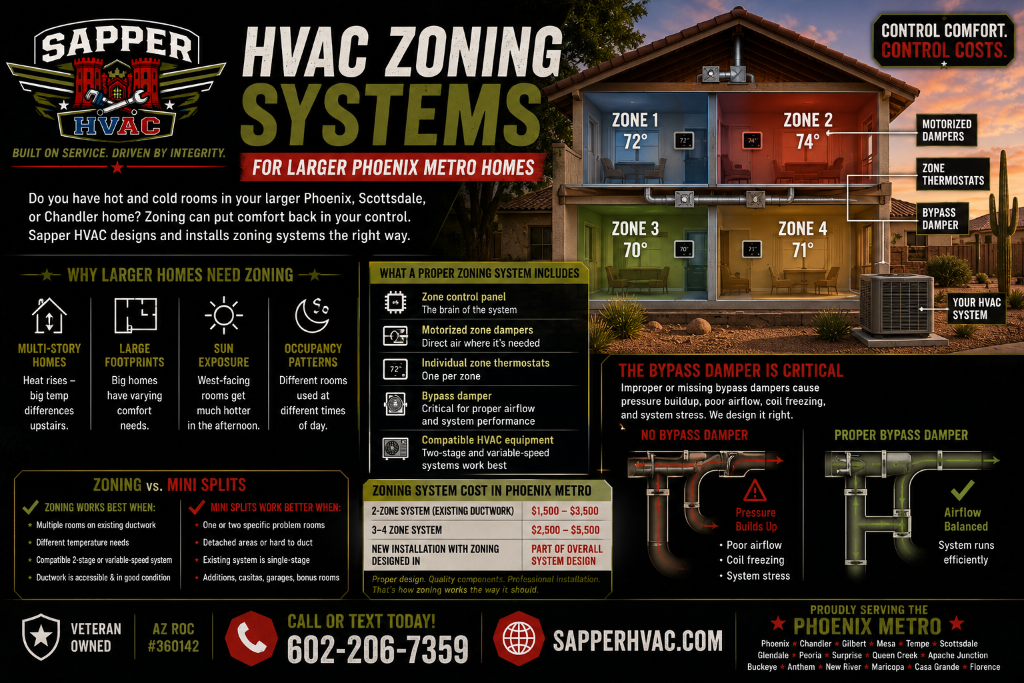
Do you have hot and cold rooms in your larger Phoenix, Scottsdale, or Chandler home? Sapper HVAC explains HVAC zoning systems and whether they're the right solution for your Arizona home.
If you have a larger home in Phoenix, Scottsdale, Chandler, Gilbert, or the surrounding metro area with rooms that are consistently too hot or too cold despite your AC running, you've probably wondered whether a zoning system would solve the problem. Zoning is a genuine solution for the right situation — but it's also one of the most commonly misunderstood and poorly installed HVAC upgrades in the Phoenix market.
What Is HVAC Zoning?
An HVAC zoning system divides your home into separate temperature zones — each controlled by its own thermostat. Motorized dampers installed in your ductwork open and close under the control of a zone controller to direct conditioned air to whichever zones need it.
Why Larger Phoenix Metro Homes Often Need Zoning
- Multi-story homes: Heat rises — a two-story home in Scottsdale or Chandler typically has significantly different temperatures on the first and second floors
- Large single-story footprints: A 3,500+ sq ft single-story home may have master suites, great rooms, and casitas with very different solar exposures
- Rooms with different sun exposure: A west-facing master bedroom heats up dramatically in the afternoon while east-facing rooms are cooler
- Different occupancy patterns: Occupied bedrooms at night vs. occupied common areas during the day
What a Properly Designed Zoning System Includes
- Zone control panel: The brain of the system
- Motorized zone dampers: Installed in duct branches serving each zone
- Individual zone thermostats: One per zone
- Bypass damper: Critical component — when some zones are satisfied and dampers close, the remaining airflow needs somewhere to go. A properly sized bypass damper prevents pressure buildup
- Compatible HVAC equipment: Single-stage systems can be zoned, but two-stage and variable-speed systems work significantly better
The Bypass Damper Problem — Why Zoning Fails in Many Phoenix Homes
The most common cause of zoning system problems is an improperly sized or missing bypass damper. When dampers close for satisfied zones, airflow is restricted. If there's nowhere for that air to go, pressure builds in the duct system, the air handler works against excessive resistance, and several problems develop: reduced airflow to open zones, air handler motor stress, coil freezing, and comfort complaints.
A properly installed zoning system includes careful static pressure calculation and a correctly sized bypass damper. This is where many contractors cut corners — Sapper HVAC does not.
Zoning vs. Mini Splits — Which Is Right for Your Phoenix Home?
- Zoning works best when: Multiple rooms connected to existing ductwork have different temperature needs; the home has a compatible two-stage or variable-speed HVAC system; ductwork is accessible and in good condition
- Mini splits work better when: One or two specific rooms are the problem; the problematic area is detached or hard to duct; the existing system is single-stage
Zoning System Cost in Phoenix Metro
- 2-zone system added to existing ductwork: $1,500 – $3,500
- 3–4 zone system: $2,500 – $5,500
- New installation with zoning designed in: Part of overall system design — most cost-effective approach
We serve Phoenix, Chandler, Gilbert, Mesa, Tempe, Scottsdale, Glendale, Peoria, Surprise, Queen Creek, Apache Junction, Buckeye, Anthem, New River, Maricopa, Casa Grande, and Florence.
Contact Sapper HVAC for an honest zoning assessment. We'll tell you whether zoning, mini splits, or a different solution is the right answer for your specific home.