

Compare single-zone vs multi-zone mini splits, efficiency ratings, sizing, refrigerant, rebates, and room-by-room recommendations for Phoenix homes.
The garage is 15 degrees hotter than the house. The casita feels comfortable only after the central AC has been running all afternoon. A back bedroom stays warm while the rest of the home is already cool. For many Phoenix homeowners, the best ductless mini split system isn't a whole-house replacement. It's a properly sized, efficient solution for the one space your existing HVAC system can't handle.
This guide takes a practical Arizona approach: single-zone vs multi-zone equipment, efficiency ratings that matter in Phoenix, sizing, refrigerant, rebates, and which setup fits different rooms.
Why the Best Ductless Mini Split System Depends on Your Space
A central HVAC system can cool the main home well and still leave a garage, Arizona room, casita, office, or distant bedroom uncomfortable. Long duct runs, attic heat, closed doors, insulation gaps, and solar exposure all work against one central thermostat.
A ductless mini split puts the indoor air handler directly in the problem area. It does not depend on a duct network to move conditioned air, which makes it a practical option for add-on spaces, retrofits, converted garages, and rooms the original HVAC system was never designed to serve.
Start with the room, not the brand
- Conditioned area: One room, a connected addition, or several separated spaces?
- Heat load: West-facing glass, roof exposure, insulation, occupancy, equipment, and garage doors all matter.
- Operating schedule: A room used all day has different efficiency priorities than a guest room.
- Heating requirement: Phoenix winters are mild, but a heat pump can still be useful in a casita, office, or bedroom.
- Electrical and line-set path: The outdoor unit needs a suitable location and the refrigerant lines need a clean route.
For more examples, see mini split ideas for Phoenix casitas, Arizona rooms, and shops.
Single-Zone vs Multi-Zone Mini Splits
The quickest answer is simple: choose single-zone for one problem room. Choose multi-zone when several rooms need independent control and one outdoor unit is more practical.
| Criterion | Single-Zone | Multi-Zone |
|---|---|---|
| Best fit | One garage, bedroom, office, or casita | Several rooms or a connected addition |
| Zoning | One indoor area | Independent control across multiple areas |
| Installation | Usually simpler routing | More complex capacity and line-set planning |
| Redundancy | A failure affects one zone | One outdoor-unit failure can affect several zones |
| Phoenix example | One hot west bedroom | A casita with separate living and sleeping areas |
A single-zone system is usually the cleaner starting point for a detached garage workshop, home office, or back bedroom. Multi-zone equipment makes more sense when several rooms need coordinated control and you want fewer outdoor condensers.
Do not choose multi-zone only because one outdoor unit looks tidier. Ask what happens if that condenser needs service during a Phoenix heat wave. With single-zone equipment, one problem generally stays isolated to one room. With multi-zone equipment, shared outdoor equipment can affect every connected space.
Practical rule: If one room is uncomfortable, buy for that room. If several rooms have a documented comfort problem, design the zones together.
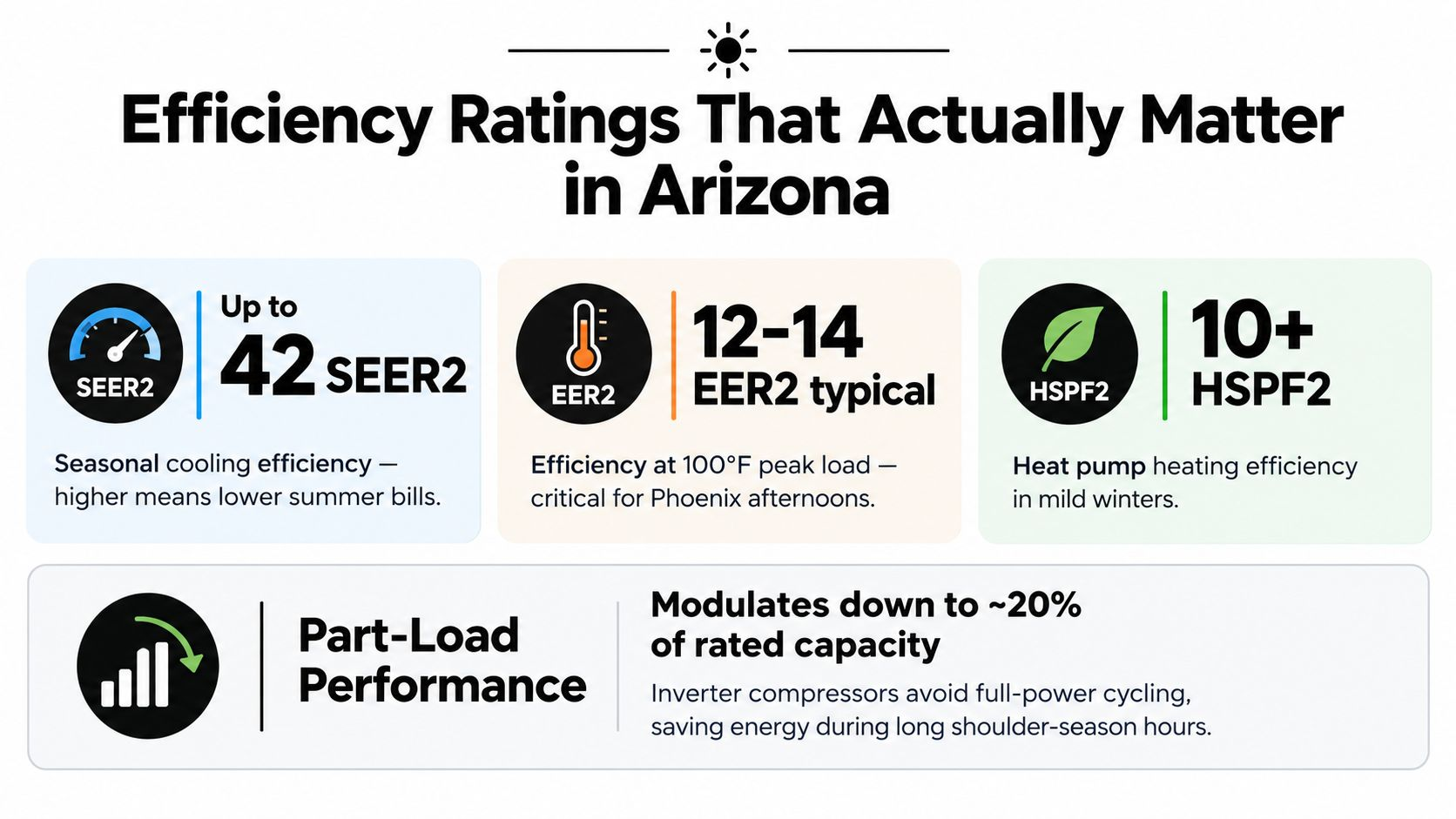
Efficiency Ratings That Actually Matter in Arizona
SEER2 measures seasonal cooling efficiency. EER2 describes efficiency under a specific operating condition and deserves extra attention during heavy Phoenix cooling demand. HSPF2 measures seasonal heat-pump heating efficiency.
For Phoenix buyers, the headline SEER2 number is only the first filter. A system can advertise a strong seasonal rating and still be a poor fit if it struggles at peak outdoor temperatures, cycles aggressively, or cannot reduce output smoothly when the room needs only a small amount of cooling.
Efficiency snapshot from the supplied guide:
- SEER2: seasonal cooling efficiency; higher ratings can mean lower seasonal cooling energy use.
- EER2: useful for evaluating efficiency during heavier peak-load conditions.
- HSPF2: relevant when the mini split will provide regular winter heat.
- Part-load performance: inverter compressors can reduce output instead of repeatedly shutting off and restarting.
Part-load performance is the Phoenix differentiator
Inverter-driven compressors can modulate instead of operating only at full power. That is especially valuable in bedrooms, offices, and casitas that may run for long hours while needing only partial cooling.
The supplied material also highlights matched-system ratings and low-load behavior. Two systems with similar SEER2 numbers can still use different amounts of energy if one maintains comfort more efficiently at partial load.
When comparing spec sheets, check SEER2, EER2, HSPF2, matched indoor/outdoor ratings, modulation range, and how the controls behave when the room is nearly satisfied.
Sizing, Cooling Capacity, and Refrigerant
A mini split that is not sized for the room will not become a good system because it has a high efficiency rating. Phoenix heat enters through roofs, windows, walls, doors, and air leakage. Garages also gain heat from slabs, vehicles, tools, lighting, and repeated door openings.
An undersized system may run continuously and still miss the thermostat target during the hottest afternoon hours. An oversized system can satisfy the thermostat too quickly, cycle more often, and provide less consistent comfort.
What the installer should evaluate
- Roof and wall insulation
- Garage-door construction
- West-facing windows and solar exposure
- Ceiling height
- Internal heat from computers, lighting, appliances, vehicles, or tools
- Air leakage around doors and penetrations
- How often and how long the room will be used
A room-by-room load calculation gives the contractor a defensible basis for capacity selection instead of choosing equipment from a rough square-foot chart.
Buy into the current refrigerant platform
The supplied article emphasizes the 2025 refrigerant transition and the shift away from R-410A toward lower-GWP platforms such as R-32. For a 2026 purchase, ask which refrigerant the exact model uses, how the manufacturer supports it, and whether local technicians stock the tools and materials needed to service it.
Get the exact indoor and outdoor model numbers, refrigerant designation, warranty terms, and service plan in writing before signing.
Costs, Rebates, and Tax Credits in Arizona
A Phoenix homeowner can receive very different quotes for the same basic mini split project because equipment is only part of the cost. Electrical work, line-set length, wall access, condenser placement, mounting, drainage, and the number of zones all affect the final number.
Be cautious with any firm quote that is given without asking about the space, electrical panel, condenser location, line routing, and condensate drainage.
The supplied guide notes that rebate eligibility can depend on efficiency, inverter operation, equipment type, utility territory, installation date, and where the system is installed. It reports examples of inverter-driven mini split heat-pump rebates tied to per-ton amounts and efficiency thresholds, but homeowners should confirm the current program directly with the applicable utility before ordering equipment.
Read the utility fine print before installation
- Identify the utility: SRP, another utility, or a local cooperative.
- Verify the current program: Equipment type, efficiency threshold, eligible models, paperwork, and deadlines.
- Confirm the installation location: Ask specifically about garages, workshops, casitas, and detached structures.
- Match the equipment: Get the exact indoor and outdoor model numbers before approving the proposal.
- Save documentation: Invoice, qualification information, permit records, and contractor paperwork.
Garage projects deserve extra scrutiny because some programs may exclude non-home spaces even when the equipment itself meets the efficiency requirement.
Our Recommendations by Room and Use Case
Garage or workshop
Choose a single-zone heat pump when the garage is the only problem area. Prioritize strong cooling at high outdoor temperatures, durable installation, and controls that can handle changing occupancy and door activity.
Recommendation: Use a properly calculated single-zone system, with premium efficiency when the room runs regularly.
Casita or accessory dwelling
A casita can benefit from multi-zone equipment when separate living and sleeping spaces need independent control. If the layout is open and compact, one indoor head may work, but one wall-mounted unit should not be expected to push comfortable air through several closed rooms.
Recommendation: Use separate zones for genuinely separate rooms.
One hot bedroom or office
A single-zone inverter system is a sensible choice for a back bedroom, nursery, office, or media room that falls behind the central system.
Recommendation: Favor low-load performance and quiet comfort over the largest capacity available.
Small commercial room
A salon room, office, retail extension, or workshop may need a single-zone or multi-zone commercial layout depending on room separation and operating schedule.
Recommendation: Design around the business schedule and internal heat sources, and include service access from day one.
Choosing an Installer and Getting a Fair Quote
The best equipment can perform badly when the installation is rushed. Refrigerant lines need clean routing and correct connections. The system needs proper evacuation, testing, drainage, electrical work, and commissioning. The outdoor unit also needs reasonable airflow and service access.
Ask every contractor:
- Was a load calculation performed?
- What are the exact indoor and outdoor model numbers?
- Who covers labor warranty versus manufacturer warranty?
- How will the line set be routed and protected?
- What electrical work, condensate management, mounting, startup, and cleanup are included?
- Who handles future warranty service and maintenance?
Sapper HVAC is a veteran-owned, licensed, bonded, and insured HVAC contractor serving Chandler and the Phoenix Metro Valley under ROC #360142.
For questions, call (602) 206-7359, email [email protected], or visit 6505 W Frye Rd, Ste 21, Chandler, AZ 85226.
Find the Best Ductless Mini Split System for Your Space
Sapper HVAC can evaluate single-zone and multi-zone ductless systems for Phoenix homes, casitas, garages, offices, and other difficult rooms with clear equipment recommendations and installation details.