Arizona heat, long cooling runtimes, and electrical stress can contribute to AC capacitor problems. Learn the warning signs, what a technician tests, and how to reduce avoidable stress on your system.
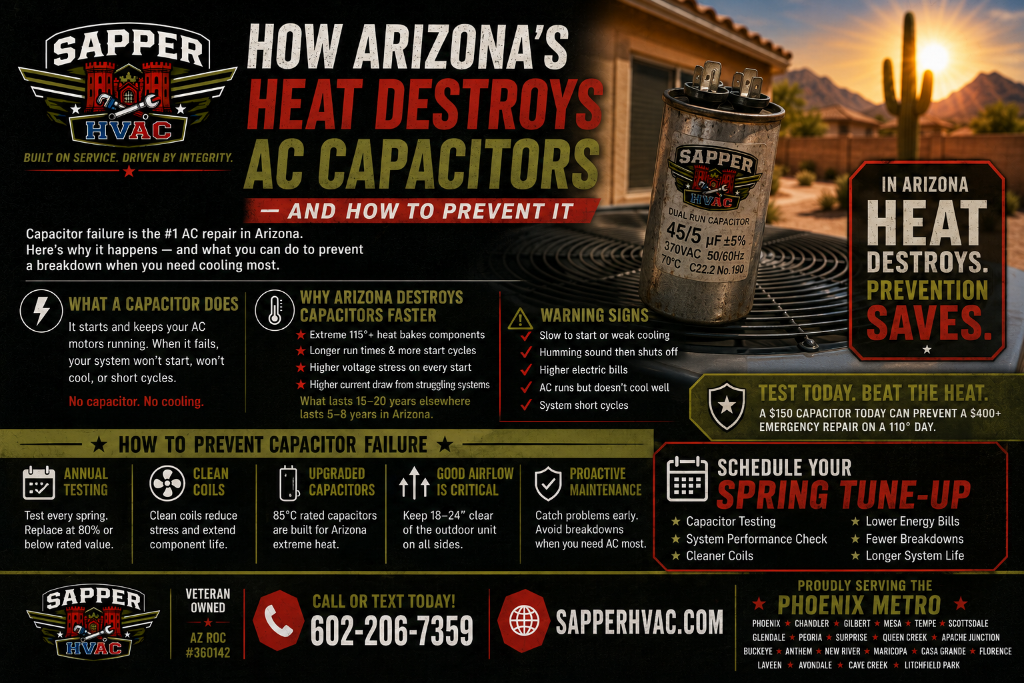
Arizona heat does not automatically mean your AC capacitor will fail, but high outdoor temperatures, long cooling runtimes, electrical stress, and aging equipment can all contribute to capacitor problems. A weak or failed capacitor can cause the outdoor unit to hum without starting, the condenser fan to stop or spin slowly, the compressor to struggle to start, or the system to shut off unexpectedly.
If your AC is having those symptoms, do not replace a capacitor based on symptoms alone. Motor, contactor, wiring, voltage, control, and compressor problems can look similar. Sapper HVAC starts with testing so the repair is based on what actually failed.
What an AC Capacitor Does
A capacitor stores and releases electrical energy to help certain HVAC motors start and run. Residential outdoor units commonly use capacitors in the compressor and condenser-fan circuits. As a capacitor weakens, the connected motor may have trouble starting or may operate outside its normal electrical conditions.
Why Arizona Heat Is Hard on AC Capacitors
High Outdoor Temperatures
Capacitors sit inside outdoor condensing equipment that operates through Arizona's hottest weather. Elevated temperatures can accelerate aging of electrical components, especially when the equipment is already dirty, poorly ventilated, or under heavy load.
Long Cooling Runtimes
Phoenix-area systems operate for much of the year. More operating hours and more start cycles mean more total electrical and thermal stress on components including capacitors, contactors, fan motors, and compressors.
Other Electrical or Mechanical Problems
A dirty condenser coil, failing motor, poor electrical connection, abnormal voltage, or compressor problem can increase stress on the circuit. That is why a capacitor should be tested along with the equipment it serves rather than treated as an isolated part.
Common Signs of a Weak or Failed AC Capacitor
- Outdoor unit hums or clicks but does not start
- Condenser fan does not start or spins slowly
- Compressor struggles to start
- System starts intermittently
- Breaker trips or the outdoor unit shuts down
- AC runs but the home is not cooling because the outdoor unit is not operating correctly
These symptoms can overlap with other failures. For a broader troubleshooting guide, see why an AC can run but not cool in Arizona.
How Sapper HVAC Tests an AC Capacitor
A technician can isolate and test the capacitor against its rated capacitance, inspect for visible swelling or leakage, and check the related motor circuit, contactor, wiring, voltage, and operating condition. The goal is to identify whether the capacitor itself failed or whether another problem is contributing to the symptom.
See our AC capacitor diagnosis and repair service or HVAC diagnostics for more information.
Can You Prevent Capacitor Failure?
No maintenance routine can guarantee a capacitor will never fail, but reducing unnecessary heat and electrical stress can help the entire outdoor unit operate under better conditions.
- Keep the outdoor coil clean. A dirty condenser has to work harder to reject heat.
- Maintain clear airflow around the outdoor unit. Do not block the condenser with storage, vegetation, or debris.
- Replace dirty air filters. Good indoor airflow helps the full refrigeration system operate correctly.
- Have electrical components checked during maintenance. A technician can identify visibly damaged or out-of-range components before they create a no-cool call.
- Do not repeatedly reset a tripping breaker. Repeated trips can indicate a larger electrical or mechanical problem.
Should a Weak Capacitor Be Replaced Before It Fails?
If testing shows a capacitor is outside the manufacturer's acceptable range or is visibly damaged, the technician can explain the condition and quote the repair. Age alone is not enough reason to replace a capacitor, and Sapper HVAC does not recommend changing parts without testing them first.
What Does AC Capacitor Repair Cost?
The final repair price depends on the exact capacitor, equipment configuration, related electrical issues, access, and whether another failed component is involved. Sapper HVAC starts with a $149 service call. If you approve the repair, the $149 service-call charge is applied toward the repair cost.
Need Help With a Suspected Capacitor Problem?
If your outdoor unit is humming, the fan will not start, or your AC suddenly stopped cooling, call (602) 206-7359 or request service through our Phoenix Metro HVAC repair page. Sapper HVAC repairs systems installed by any contractor.
If your system is operating and you are looking for preventive maintenance instead of a repair visit, see the current free AC tune-up offer and eligibility details.